 Serving NC, SC, VA & GA — 26 Years of Experience, Comprehensive Maintenance Services, Multi-Location Support
Raleigh doesn't get northern winters. But that's exactly what makes a Triangle ice event more dangerous for your property – not less.
Carolina Sweepers has been maintaining commercial properties across North Carolina since 2000, and we've seen how quickly a quarter inch of freezing rain can shut down a retail center, trigger a slip-and-fall claim, or cost a property manager a tenant. The storms here are unpredictable, infrequent enough that most lots aren't prepared, and icy enough to do real damage fast. This article is for property managers who are thinking clearly about that risk before the first storm of the season hits – not after.
Table of Contents
- Why Raleigh Winter Events Are a Different Problem Than Up North
- What Commercial Snow Plowing in Raleigh Actually Includes
- Why Pre-Treatment Matters More Than the Plow Truck
- When to Lock In a Contract – and Why Waiting Costs You
- How Carolina Sweepers Handles a Snow Event, Start to Finish
- The Single-Source Advantage: Snow Removal and Everything Else
- Coverage, Response Times, and What to Expect on Day One
- FAQ
Why Raleigh Winter Events Are a Different Problem Than Up North
A Minneapolis property manager expects snow. They've got a contract, they've got sand buckets at every entrance, and their tenants have seen a February blizzard before. Raleigh is a different situation entirely.
Here, a single-digit temperature drop with a little moisture behind it can glaze an entire parking lot in two hours – and it often happens overnight, when no one's watching. The storm total might be a quarter inch of precipitation. By northern standards, that's nothing. By Triangle standards, it can mean a full parking lot closure and 40 calls to your phone before 8 a.m.
A few things that make Raleigh's winter weather particularly tricky for commercial property:
- Freeze-thaw cycling. We rarely get sustained cold. Temperatures might dip below freezing overnight, climb into the 40s by noon, and drop again the following night. That cycle turns treated pavement back into a hazard faster than a sustained cold snap would.
- Black ice on asphalt. Because we don't get heavy snowfall to cover it, ice here is often invisible – especially on darker pavement that hasn't been pre-treated. Tenants and customers walk right into it.
- Compressed timelines. A storm system in the Triangle can move from forecast to accumulation in six to eight hours. If your vendor doesn't have a plan already built around your property, they're improvising – and that's when curbs get hit, drainage areas get buried, and your lot reopens slower than it should.
None of this means Raleigh winters are worse than Boston winters. They're just worse in a different way – the kind of way that catches people off guard.
What Commercial Snow Plowing in Raleigh Actually Includes
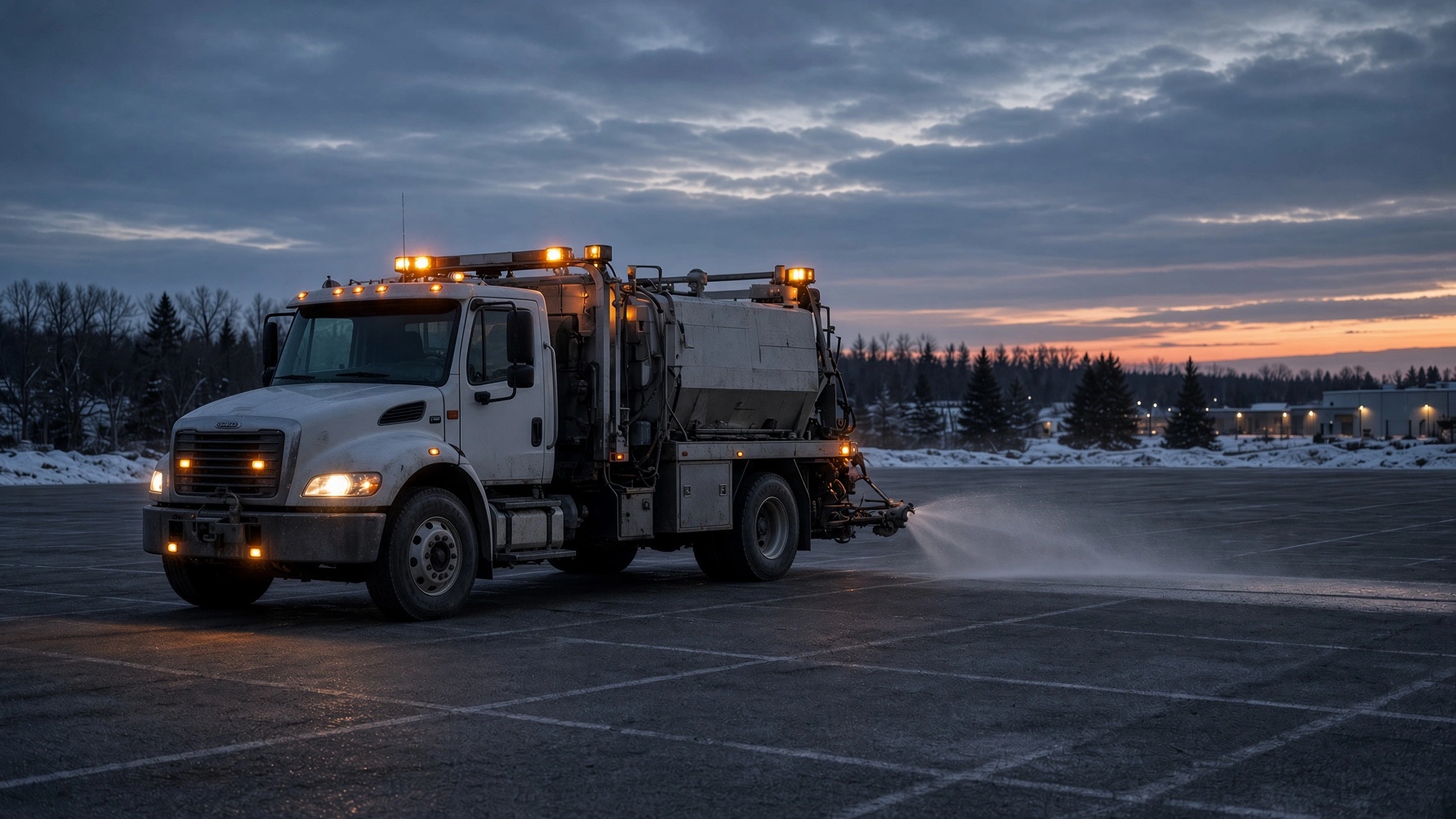
The term “snow plowing” undersells what a real commercial response looks like. Plowing is one piece of it. Here's what a full-service snow and ice response for a commercial property typically covers:
- Pre-treatment. Liquid or granular treatments applied before a storm hits – to parking surfaces, walkways, and entry points. Pre-treatment is what keeps ice from bonding to pavement in the first place. It's the part most thin-service vendors skip.
- Plowing. Moving accumulated snow off driving lanes, parking stalls, fire lanes, and loading areas. On commercial properties, this isn't just pushing snow to the edge – it's understanding where snow can't go (storm drains, accessible parking spaces, tenant entry points) and where it can.
- Salting and de-icing. Applied after plowing, and often again after freeze-thaw cycles, to suppress refreeze. Application rates matter – too light and you refreeze; too heavy and you're damaging pavement and tracking chloride into your building's entryways.
- Walkway clearing and treatment. Lot access means nothing if the path from the car to the door is still a sheet of ice. Sidewalks, crosswalks, and covered entry areas all need attention separately.
- Monitoring and return visits. In a freeze-thaw climate, one visit isn't always enough. A responsible vendor checks conditions as temperatures fluctuate and returns if refreeze creates new hazards.
What you're paying for, ultimately, is a property that stays open and stays safe – not just a lot that got plowed once.
Why Pre-Treatment Matters More Than the Plow Truck

If you've never seen a commercial property pre-treated before a storm, it looks almost uneventful. A truck does a slow pass over the lot and drive lanes applying a liquid or granular deicer. Takes maybe 20 minutes for a mid-size retail lot. And then nothing happens – which is exactly the point.
Pre-treatment prevents ice from forming a bond with the pavement surface. When it works, snow and sleet accumulate on top of the treatment layer rather than fusing to the asphalt, which means clearing is faster, you use less salt afterward, and the lot is safer for longer. It also means your vendor is working with the storm instead of chasing it.
In northern markets, pre-treatment is standard. In Raleigh, it's still something property managers have to ask for explicitly – and plenty of vendors skip it because the cost hits before the storm does, which makes it harder to sell.
Here's what we'd say plainly: if a snow removal vendor isn't talking to you about pre-treatment as part of the plan, they're offering you a reactive service. Reactive works fine when you have an inch of fluffy snow and four hours of cold. It doesn't work well when you've got a half-inch of sleet, temperatures bouncing around freezing, and a tenant base that opens at 7 a.m.
Ask the question directly before you sign anything: Is pre-treatment included, and when does it get deployed?
When to Lock In a Contract – and Why Waiting Costs You
The honest answer: before October. The practical answer: right now, whenever you're reading this.
Commercial snow removal contracts in the Triangle are not the commodity they might be in markets that get reliable snowfall every year. Raleigh's winter events are infrequent enough that vendors sometimes lean on equipment and labor allocation, prioritizing clients who are already contracted when a storm materializes. If you're calling a provider the morning of a forecast, you're already competing with everyone else who waited.
There's also a coverage quality issue. A vendor who adds your property last-minute – mid-storm or right before one – hasn't walked your lot. They don't know where your drainage runs, which areas ice over first, whether your lot has ADA spaces that need to stay clear, or what access restrictions your tenants operate under. A walkthrough before the season starts is how a professional service actually prepares.
Beyond logistics, there's a pricing reality. Per-event pricing in a thin-inventory market tends to be higher than seasonal or contract-based arrangements, and it comes with no guarantee of priority response. A pre-season contract typically locks in response time commitments and first-call priority – and at Carolina Sweepers, bundling snow removal with other winter and seasonal property services can reduce overall property maintenance costs by up to 30%.
None of this is meant to pressure you into a decision – it's meant to describe what we actually see happen when property managers delay. One bad storm without a plan is usually the last time it happens.
How Carolina Sweepers Handles a Snow Event, Start to Finish
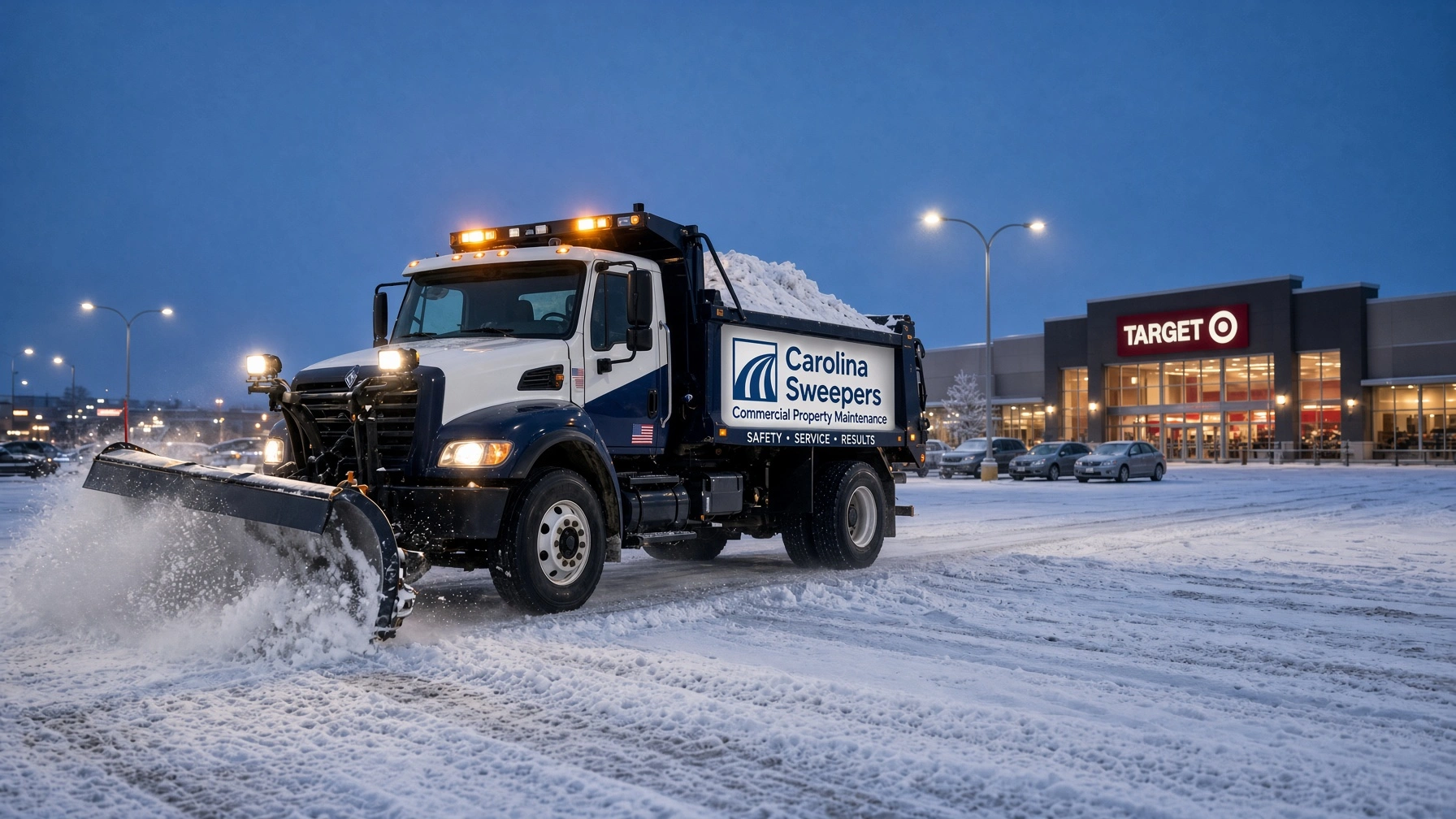
When Carolina Sweepers takes on a commercial snow account, the process starts well before any forecast.
- Property walkthrough. We document the lot layout – entrance points, fire lanes, drainage locations, ADA spaces, equipment staging areas, snow deposit zones, and any surface conditions that affect how we work (existing asphalt damage, speed bumps, curb overhangs). This map becomes the basis for the crew's site plan.
- Threshold triggers. Your contract specifies when service activates – typically based on accumulation or temperature thresholds. You shouldn't be making a judgment call at 11 p.m. about whether to call for service. That decision is pre-made.
- Pre-storm treatment. For forecast events that meet trigger criteria, our crews treat surfaces in advance. This is dispatched based on weather monitoring, not a phone call from you.
- Storm response. Our 100+ trucks and equipment give us the capacity to run multiple simultaneous sites across the Triangle without pulling resources from one property to cover another. Crew assignments are pre-set. Your lot doesn't get deprioritized because a competitor's lot needed extra passes.
- Post-storm follow-up. After plowing and salting, we monitor forecast temperatures. If a refreeze event is likely, we return. If conditions are clear, we document completion and communicate status.
- Communication throughout. Property managers who work with Carolina Sweepers know to expect a call or message when service is complete – not silence until morning. If we find something during the event (a storm drain that's backed up, a section of lot that's developing a drainage issue), we flag it.
That's what a professional response looks like. Not complicated – just consistent.
The Single-Source Advantage: Snow Removal and Everything Else
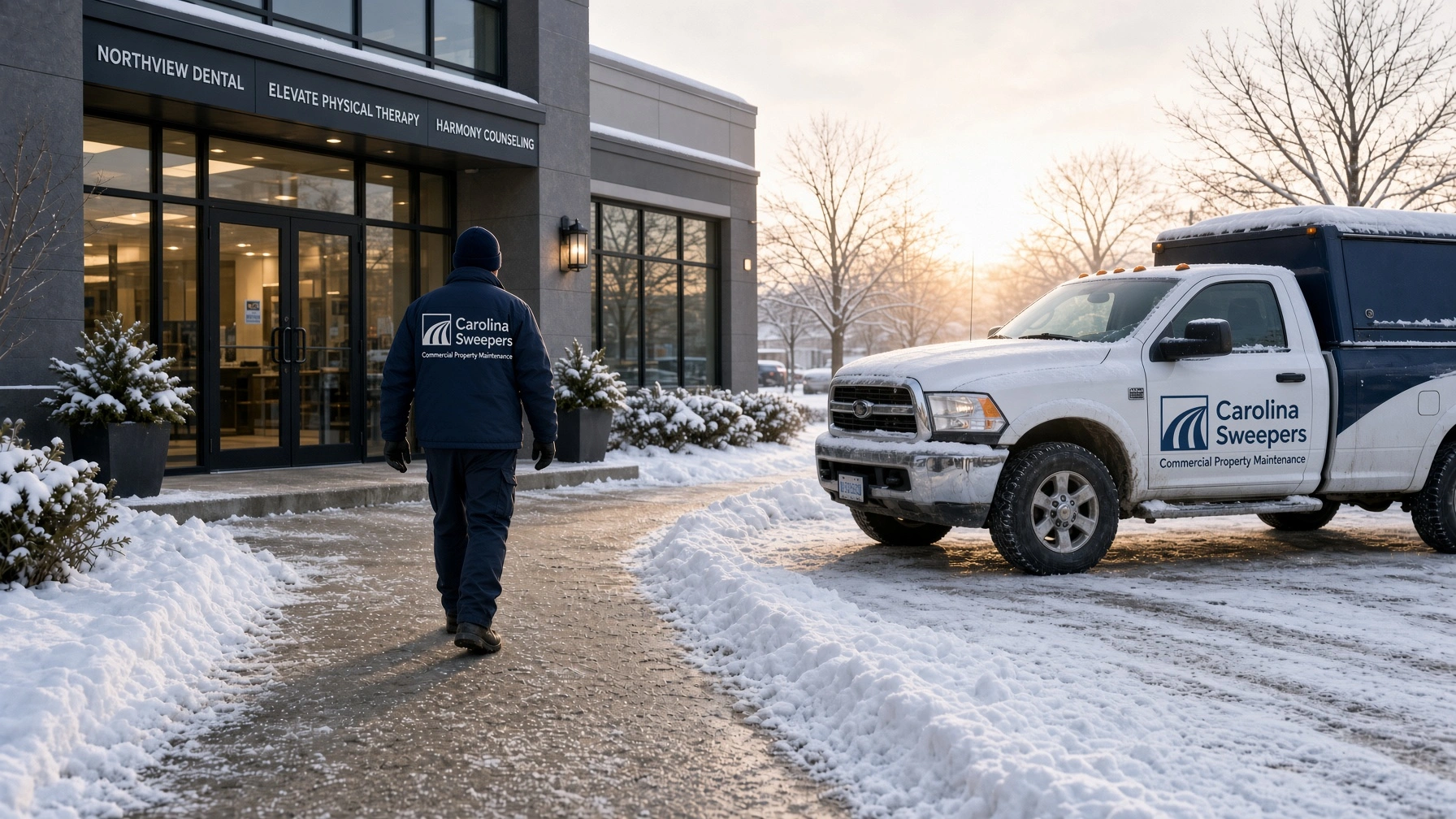
Snow plowing as a standalone service is fine if that's all you need. But most commercial properties in the Triangle are managing winter as one piece of a larger year-round maintenance picture – parking lot sweeping, pressure washing, line striping, landscaping, and seasonal services all feeding into the same operational budget and the same property condition.
Working with a single provider across those services changes the dynamic in ways that matter.
- One point of contact. When there's a question about what got treated, what's scheduled next, or whether a post-storm pressure wash is needed to clear salt residue from entryways, you're not chasing three vendors. You call one number.
- Coordinated scheduling. A provider who handles both sweeping and snow removal doesn't schedule a lot sweep the same night we're expecting pre-treatment deployment. These things get coordinated automatically – not because of some formal process, but because it's the same team looking at the same calendar.
- Bundled pricing. Up to 30% in savings is real. It's not a discount we discount our way into – it's the efficiency gain of running multiple services for the same property with shared site knowledge, fewer mobilization costs, and one service agreement instead of five.
Carolina Sweepers currently maintains 1,000+ commercial properties with 17 services under one account structure. Property managers who've consolidated know how much friction disappears when the vendor coordination problem goes away.
Coverage, Response Times, and What to Expect on Day One
Carolina Sweepers provides commercial snow plowing and ice removal across the Triangle – Raleigh, Cary, Durham, Apex, Morrisville, Chapel Hill, and surrounding communities – as part of a broader service footprint that extends across NC, SC, VA, and GA.
For Triangle commercial properties specifically, our standard contract terms include:
- Pre-storm treatment at forecast trigger thresholds
- On-site response for active accumulation events
- Post-storm monitoring for refreeze conditions
- 24/7 emergency line — (919) 481-9003
If you're bringing us a new property, the process starts with a walk-through. We look at the lot, document what we need to know, and put together a service plan based on your actual property – not a boilerplate agreement. There's no cost to the walk-through, and it's how we make sure we're actually prepared when something happens at 2 a.m.
A few things we'd encourage you to bring to that conversation:
- Your current vendor situation (or lack of one)
- Any prior events where your property had issues – drainage, refreeze, tenant access
- What other maintenance services you're currently managing and who's handling them
That context helps us build something useful instead of something generic.
If you manage a commercial property in the Raleigh area and you haven't locked in snow coverage yet, this is a reasonable time to do it – before the first forecast of the season makes the phone lines busy.
Carolina Sweepers — (919) 481-9003, available 24/7 or contact us via the website. Walk-throughs are free, and there's no obligation to decide on the spot.
FAQ
How often does it actually snow in Raleigh, NC?
Not often – and that's the problem. Raleigh averages one to three winter weather events per season, sometimes fewer. The unpredictability is what trips up property managers. You can go two mild winters in a row and assume you don't need a plan, and then February hands you two ice storms in the same week. When it does happen, it happens fast.
Is commercial snow removal different from residential?
Yes, significantly. Residential plowing is mostly about driveways. Commercial snow removal means clearing large asphalt areas – parking lots, fire lanes, loading docks, ADA-accessible paths – while keeping them legally passable and safe for foot traffic. The equipment is heavier, the scheduling is tighter, and the liability stakes are much higher. A slip-and-fall in your lot is your problem, not the weather's.
What does commercial snow plowing actually include?
A full-service commercial response typically covers: pre-treatment with liquid or granular ice melt before the storm, plowing the lot once accumulation is sufficient, clearing fire lanes and dumpster access, and post-storm salting to prevent refreeze. Some contracts also include sidewalk clearing. The specific scope depends on your property's layout and what you've agreed to in advance – which is why the contract conversation matters.
How much does commercial snow plowing cost in Raleigh, NC?
Pricing varies by property size, service scope, and contract structure. For a mid-size retail parking lot in the Triangle, per-event pricing can range considerably depending on acreage, whether pre-treatment is included, and how fast you need the property cleared. Seasonal contracts tend to run lower per-event because the vendor is budgeting across the whole winter rather than quoting one storm at a time. Carolina Sweepers can walk through your property and give you a straight number – call (919) 481-9003 to schedule that.
Do I need a snow removal contract, or can I just call when it snows?
You can call – but you probably won't get the response time you need. When a storm hits the Triangle, vendors fill their schedules fast. Properties with contracts get priority dispatch. If you're calling during an active ice event without a prior agreement, you're at the back of the line. For a single-unit retail center, that might mean your lot isn't clear until mid-morning. For a multi-tenant property with opening hour obligations, that's a real problem.
What's the difference between a per-event contract and a seasonal contract?
Per-event pricing means you're billed each time a service is performed. Seasonal contracts set a flat rate for the winter, regardless of how many events occur. In a mild winter, seasonal contracts cost more per-event in hindsight. In a heavy winter, they save you money. Most commercial property managers in the Triangle prefer per-event contracts because winters here are unpredictable – but that preference should come with the understanding that you're accepting scheduling risk during active storm periods.
What happens if it snows overnight at my commercial property?
If you're under contract with Carolina Sweepers, our crews are monitoring conditions and dispatching before you wake up. We don't wait for a phone call – when a storm triggers service thresholds in your contract, we move. Your lot should be cleared and treated before your tenants arrive. That's the whole point.
How fast will a plow truck arrive at my property?
Response time depends on storm severity, geographic spread, and your contract priority level. In a localized event, we're typically on-site within a few hours of accumulation reaching trigger depth. In a widespread regional storm – the kind that catches the whole Triangle at once – response windows extend. That's honest, and any vendor who guarantees a specific arrival time in a major storm without knowing your position in their queue is overselling. What we can tell you: contracted properties are always dispatched before uncontracted calls.
Does Carolina Sweepers handle ice as well as snow?
Yes. In Raleigh, ice is usually the bigger threat anyway. A quarter inch of freezing rain does more damage to your parking lot liability exposure than two inches of snow. Pre-treatment – applying liquid deicer or granular product before the storm – is often more effective than post-storm plowing. Our crews are familiar with Triangle weather patterns and will recommend the right approach based on what the forecast is actually showing.
What cities does Carolina Sweepers cover for snow removal?
We cover Raleigh, Cary, Durham, Apex, and surrounding Triangle communities. Our service area extends across North Carolina and into SC, VA, and GA for commercial property clients. If you're not sure whether your property falls in our primary winter coverage zone, call us – (919) 481-9003 – and we'll give you a direct answer.
Can I bundle snow removal with other property services?
Yes – and it saves money. Carolina Sweepers operates as a single-source facility service provider. Snow plowing paired with pressure washing, commercial sweeping, or seasonal landscaping services can save you up to 30% compared to managing those vendors separately. One point of contact, one invoice, one call when something comes up.
When should I lock in a snow contract?
Before October. Vendors finalize their route capacity heading into fall, and properties that wait until November or December are often looking at limited availability or higher per-event pricing. If you manage a property that needs to be clear and accessible the morning after any winter event, the time to have this conversation is now – not when the forecast shows sleet.
Ready to get your property covered before the first storm? Carolina Sweepers is available 24/7 at (919) 481-9003. We'll schedule a free walk-through of your property and put together a contract that fits your lot, your tenants, and your budget.
No Comments yet!