 Serving NC, SC, VA & GA — 26 Years of Experience, Comprehensive Maintenance Services, Multi-Location Support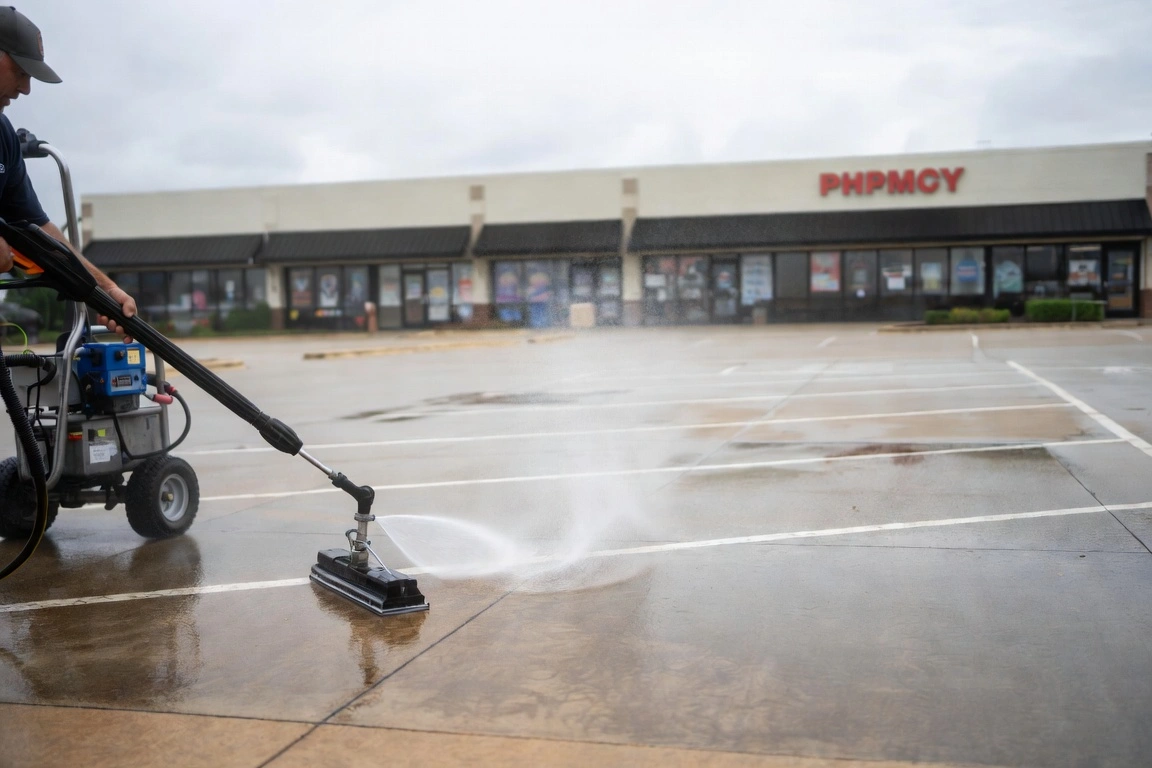
Charlotte is not an easy place to own pavement.
Between May and September, the humidity rarely drops below 60%. Red clay washes off construction sites and parking lot edges every time a storm rolls through. Grease from drive-through lanes bakes into concrete during a heat wave and then gets pressure-sealed by the next rainfall. Algae finds its way onto north-facing facades and sits there for months, looking like the building hasn’t been touched since the previous tenant moved out.
Carolina Sweepers has been maintaining commercial properties across North Carolina and the Carolinas for 26 years, and we see the same pattern in Charlotte every season: a property manager inherits a maintenance backlog, or their last vendor stopped showing up reliably, and now they’re trying to figure out what professional pressure washing actually involves — what it costs, how long it takes, and whether the company they’re talking to really knows what they’re doing.
This article answers those questions directly. No vague promises about “pristine results.” Just a clear walkthrough of what a professional commercial pressure washing service looks like, from the first site visit to the final report.
Table of Contents
- Why Charlotte’s Climate Makes Pressure Washing a Maintenance Requirement
- The Pre-Service Assessment: What Happens Before the Truck Arrives
- Surface Types and Why They Change Everything
- PSI, Temperature, and Technique: The Decisions Behind the Wand
- Stormwater and Runoff Compliance in Mecklenburg County
- Scheduling Around Tenants, Traffic, and Business Hours
- How Carolina Sweepers Approaches the Service Report
- Bundling Pressure Washing with Other Property Services
- How to Evaluate Any Pressure Washing Company in Charlotte
- FAQ
Why Charlotte’s Climate Makes Pressure Washing a Maintenance Requirement
Most property maintenance decisions are about appearance. Pressure washing in Charlotte is also about deterioration.
The combination of summer humidity, freeze-thaw cycles in winter, and the region’s heavy clay soils creates conditions that accelerate surface degradation faster than most property owners expect. Organic growth — algae, mold, mildew — doesn’t just look bad on a building facade. It traps moisture against the surface, and moisture against a masonry or EIFS exterior is how you end up with spalling, staining, and early repair bills.
Concrete is the other story. Charlotte gets roughly 43 inches of rain per year. Stormwater carries oil, sediment, and debris across parking surfaces repeatedly. Without periodic washing, that buildup compresses into the concrete pores and becomes significantly harder to remove. A lot that gets washed annually is a maintenance task. A lot that goes three years without attention is a restoration project.
The commercial properties that handle this well — the retail centers in Ballantyne and SouthPark that look clean year-round, the office parks near University City where tenants rarely complain about the exterior — almost always have a scheduled washing program, not a reactive one.
The Pre-Service Assessment: What Happens Before the Truck Arrives
A professional pressure washing company should walk your property before committing to a scope or a price. This isn’t a sales formality — it’s how we avoid problems.
At Carolina Sweepers, a pre-service site assessment typically covers:
- Surface inventory. What surfaces need washing, and what are they made of? Concrete, asphalt, brick, precast panels, EIFS (synthetic stucco), painted block — each responds differently to pressure and chemical application. A flat-rate quote that doesn’t distinguish between surfaces is a quote from someone who hasn’t thought through the job.
- Drainage and runoff paths. Where does water go when it leaves your property? Are there stormwater inlets nearby? Is there a retention pond or bioswale on the lot? This matters for compliance, and it matters for how the crew sets up. (More on Mecklenburg County’s requirements below.)
- Tenant and traffic patterns. When is your lot or building at peak occupancy? Is there a drive-through that needs to stay open? Are there loading docks with scheduled delivery windows? The assessment is where we map the logistics before they become problems on service day.
- Existing damage. Cracks in concrete, spalling on masonry, failing sealant around expansion joints — these get documented before the wash, not discovered during it. If we find something that pressure washing could worsen, you hear about it before we start.
A written site assessment also protects you. If a pre-existing crack appears after the service, you have documentation that it was there before we arrived.
Surface Types and Why They Change Everything
This is the part most property managers don’t know to ask about — and it’s where a lot of damage happens when the wrong company gets the contract.
- Concrete flatwork (parking lots, sidewalks, curb lines) is the most straightforward surface to wash, but “straightforward” doesn’t mean uniform. New concrete behaves differently than aged concrete. Sealed concrete holds up to higher pressure. Unsealed or damaged concrete can be fractured by aggressive PSI. Drive-through aprons with grease penetration usually need a degreaser dwell time before the pressure wash, not just raw water force.
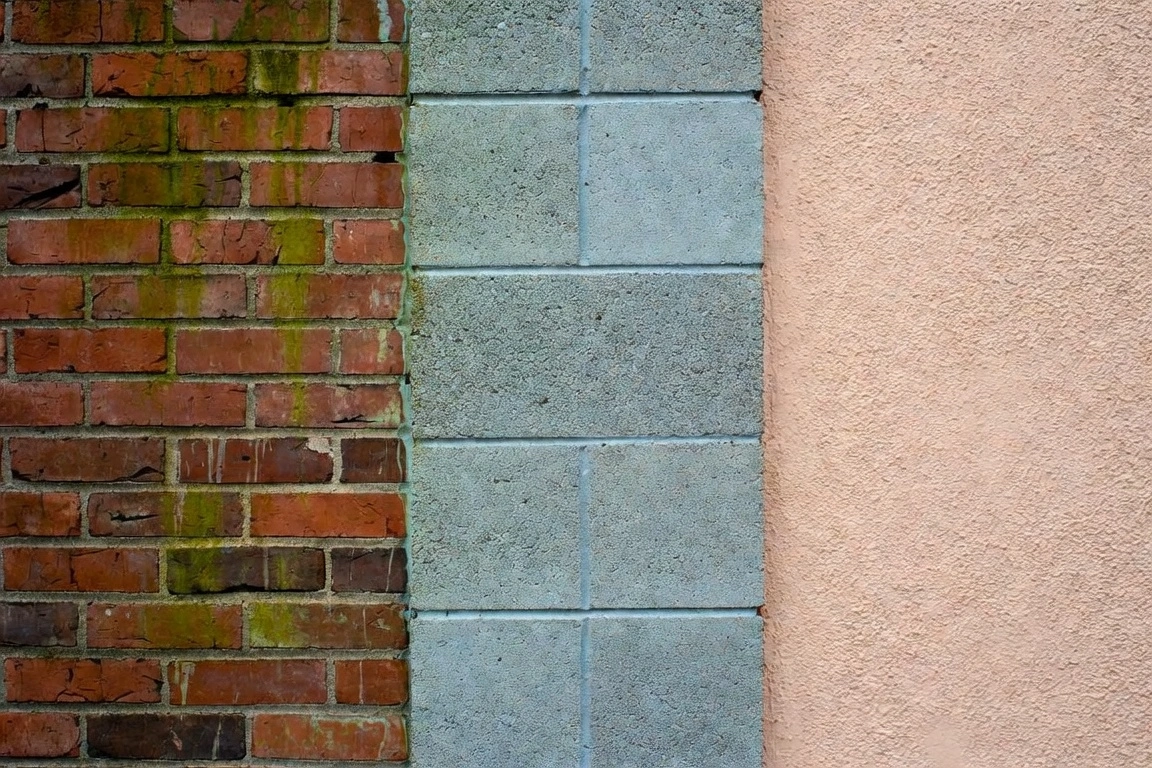
- Building facades are where the real variation lives. Standard painted CMU block handles a wide range without issue. Brick — especially older brick used in Charlotte’s historic mill buildings being converted to office and retail — is porous and can be permanently etched by too much pressure. EIFS (the synthetic stucco system common on 1990s and 2000s commercial buildings) is particularly unforgiving: too much PSI and you force water behind the system, which leads to moisture intrusion and mold problems that cost far more to repair than the facade wash was worth.
- Dumpster pads and grease trap areas are a category of their own. The biological and grease load on a restaurant pad or a food service loading dock requires hot water equipment and commercial degreasers — not the same equipment used for a sidewalk or a parking deck facade.
- Pavers and decorative concrete are common in Charlotte’s newer mixed-use developments. These require surface cleaners with controlled spray patterns rather than direct wand pressure, and many need re-sanding of joints after washing.
A professional service specifies the approach for each surface type before the work starts. If a company gives you a single-line quote — “pressure washing your property” — without acknowledging these differences, ask them to walk it with you.
PSI, Temperature, and Technique: The Decisions Behind the Wand
Property managers don’t need to become equipment experts, but understanding the basic variables helps you evaluate whether a vendor knows what they’re doing.
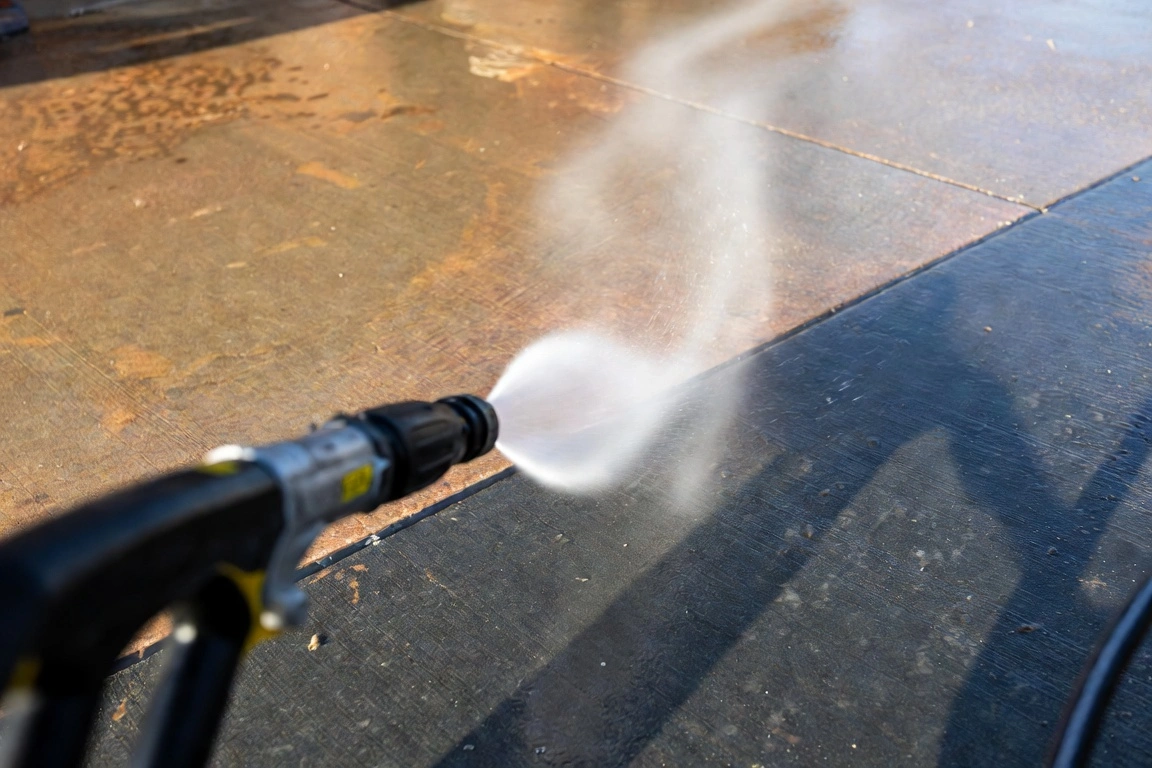
- PSI (pounds per square inch) is the pressure measurement. Commercial-grade equipment runs anywhere from 1,500 PSI on the low end for delicate surfaces to 4,000+ PSI for heavy industrial concrete. The right PSI depends on the surface hardness, the age of the material, the type of contamination, and the distance from the nozzle to the surface.
- Temperature matters more than most people realize. Cold water pressure washing is effective for general dirt, dust, and light organic growth. Hot water — technically “power washing” — is necessary for grease, oil, and biological contamination. If your property includes a fast food drive-through pad, a loading dock behind a restaurant, or any surface with recurring grease deposit, cold water alone won’t get you a clean result that lasts.
- Surface cleaners vs. wand washing. Flat surface cleaners — the disc-shaped attachment that spins two jets in a controlled pattern — produce more uniform results on flatwork and eliminate the stripe marks (called “zebra striping”) that wand washing leaves on concrete. On a large parking lot or sidewalk network, surface cleaners also move faster. For vertical surfaces and tight areas, direct wand work is still necessary.
- Dwell time and chemical application. Appropriate surfactants and degreasers, applied before the pressure wash and allowed to dwell, dramatically reduce the PSI needed to achieve a clean result — and reduce the risk of surface damage from aggressive pressure. This is where experience shows. A crew that knows they’re working on a grease-contaminated drive-through pad will apply degreaser and let it work before touching the trigger. A crew that defaults to max PSI for everything will damage the surface and still not get it clean.
Stormwater and Runoff Compliance in Mecklenburg County
This is a section some vendors skip. They shouldn’t, and neither should you.
Mecklenburg County falls under North Carolina’s stormwater management framework, and Charlotte’s storm drains flow to local waterways — Sugar Creek, Irwin Creek, the Catawba River basin. Discharging untreated wash water containing petroleum, chemicals, or biological waste into storm drains is a violation of the Clean Water Act and NC state stormwater rules, regardless of whether the water came from a commercial property wash.
What this means for your property:
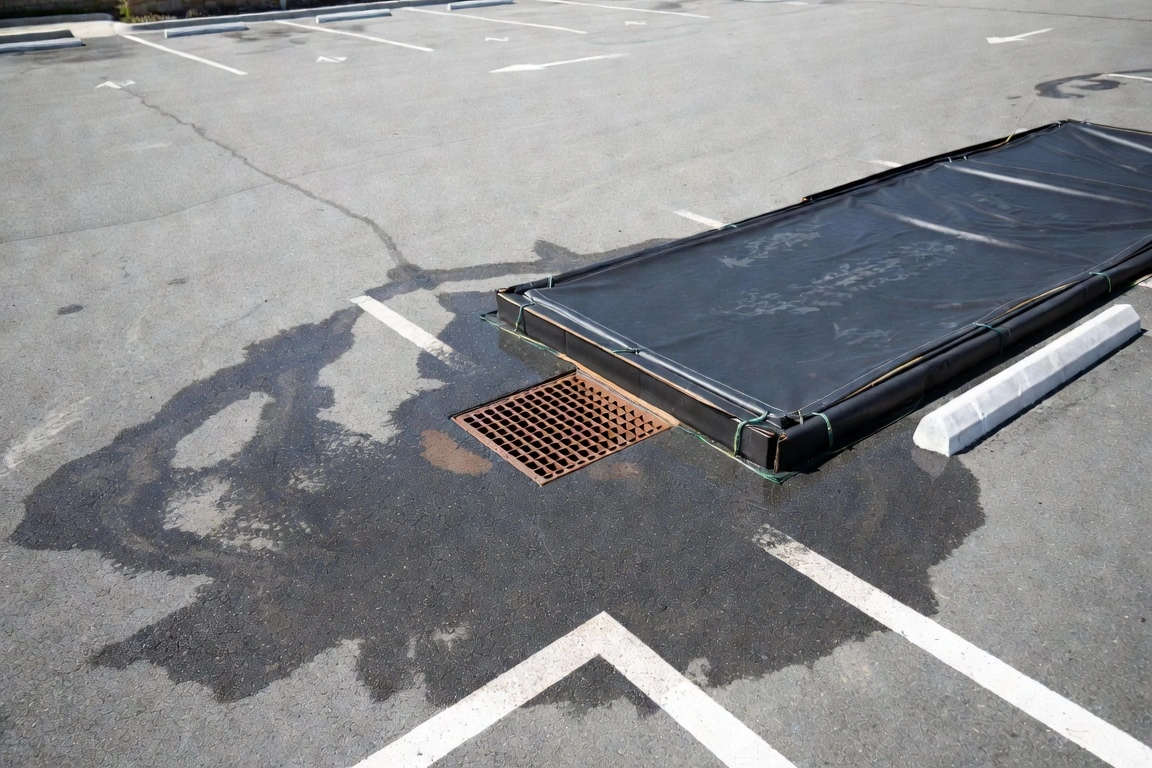
- Wash water from dumpster pads, drive-through lanes, or any surface with visible petroleum or grease contamination must be collected or redirected to a sanitary sewer connection — not allowed to flow freely into storm inlets.
- Chemical agents used during washing must be appropriate for stormwater management. Biodegradable surfactants are standard in professional jobs. Some operations use berms, vacuums, or drain plugs to contain and capture runoff during the wash.
If you’re ever audited or a complaint is filed, the liability question goes to the property owner, not just the contractor. Asking your pressure washing vendor how they handle runoff is not a nitpicky question — it’s due diligence.
Carolina Sweepers follows NC stormwater compliance protocols on commercial washes, including runoff containment on applicable surfaces. We’ll tell you what method we’re using before the work starts.
Scheduling Around Tenants, Traffic, and Business Hours
Retail centers don’t close. Medical office buildings have patients arriving at 7 a.m. Drive-throughs run from 6 a.m. to midnight. The biggest operational challenge in commercial pressure washing isn’t the wash itself — it’s finding the window to do it.
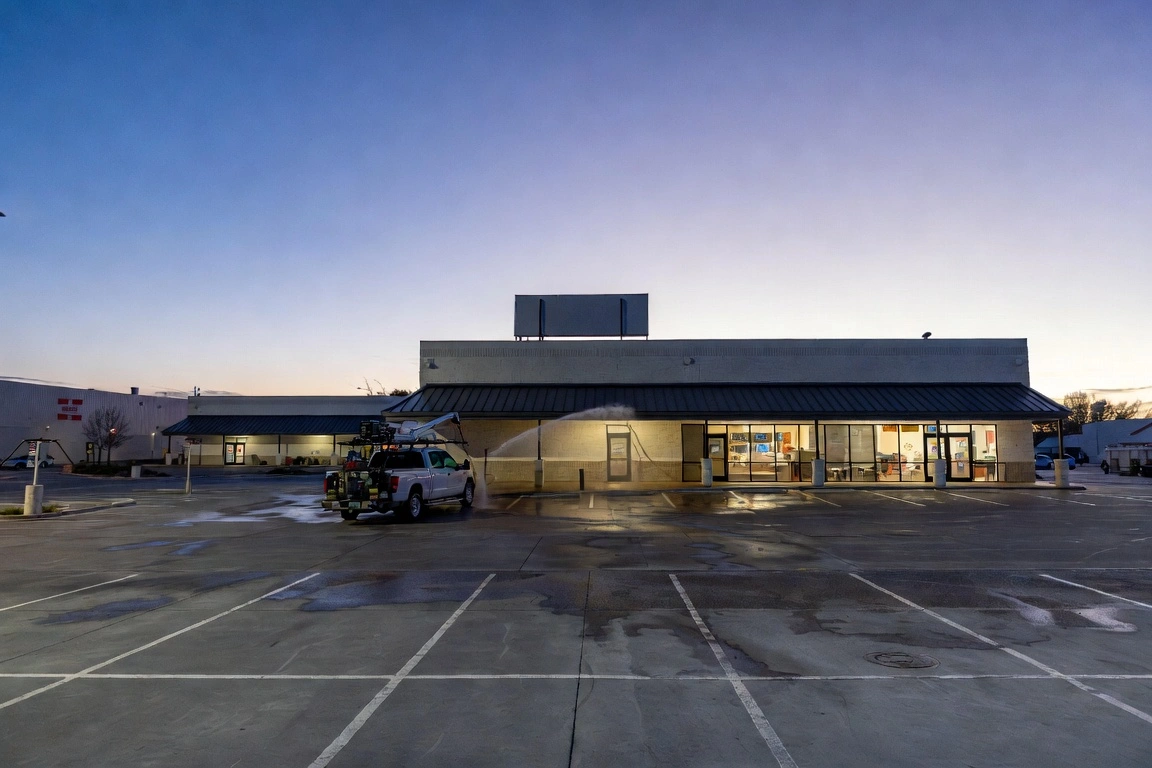
A few realities that a professional service builds around:
- Pressure washing is loud. Equipment noise runs in the 85–90 dB range at close range — comparable to a lawn mower, but sustained. Services scheduled during business hours in mixed-use or medical settings create tenant friction. Early morning (2–5 a.m.) or weekend work is often the right call for high-traffic properties.
- Wet surfaces need dry time. After washing concrete or pavers, there’s a period where surfaces are slick and need to be kept clear of foot traffic. For a shopping center with pedestrian flow, this requires either a phased approach (one section at a time) or a complete early-morning schedule before stores open.
- Building facades need to be approached when tenants are not operating windows or HVAC intakes nearby. Chemical mist and pressure wash overspray can enter buildings if intake vents are running. Your vendor should know this and schedule accordingly.
We’re available 24/7 for emergency response and schedule routine commercial washes around your property’s operating constraints — not ours. That coordination happens during the site assessment, not as an afterthought.
How Carolina Sweepers Approaches the Service Report
A pressure wash that leaves no paper trail didn’t happen — as far as your records are concerned.
After every commercial service, Carolina Sweepers provides documentation that covers:
- Surfaces washed and methods used (PSI, temperature, chemical agents)
- Any pre-existing surface conditions noted at start of service
- Any new conditions observed during washing (cracks, deterioration, drainage issues)
- Water management approach (runoff containment method used)
- Service date, time window, and crew notation
This documentation matters for three reasons. First, it gives you a maintenance log that demonstrates due diligence — useful if a tenant slip-and-fall claim ever tries to establish that the property was neglected. Second, it tells the next service crew exactly what was done and when, so they’re not guessing at the condition of the surface. Third, it’s the basis for a conversation about service frequency. If the post-wash report consistently notes heavy organic growth on a north-facing facade, that’s data supporting a quarterly schedule instead of annual.
Property managers who work with Carolina Sweepers long-term tell us the documentation is one of the things that keeps them here. They can hand it to their property owner, their insurance carrier, or their HOA board and show exactly what’s being done and when.
Bundling Pressure Washing with Other Property Services
One of the real inefficiencies in commercial property maintenance is vendor coordination. You have a sweeping company, a pressure washing company, a striping company, and a landscaping company — and they all need different scheduling windows, different access arrangements, and different invoices.
Carolina Sweepers runs 17 services under one operation. On a Charlotte commercial property, a single service visit can combine parking lot sweeping, pressure washing of the lot surface and building entrance, dumpster pad cleaning, and line striping — all coordinated as one scheduled event, with one point of contact.
For property managers who have dealt with the alternative — chasing three vendors to overlap their schedules so the lot gets swept before it gets washed, and washed before it gets re-striped — the bundling story is practical, not just convenient. You get up to 30% in savings on bundled services, and you reduce the coordination overhead that turns routine maintenance into a half-day project.
This is also where the Charlotte climate story connects to planning. If you’re washing in late spring before Charlotte’s high-humidity season sets in, that’s also the right window to re-stripe faded lot markings (UV and traffic wear from winter). Combining the two in one visit costs less and leaves the property looking genuinely maintained rather than piecemeal.
If you’re currently managing multiple vendors for services that could run together, it’s worth asking whether your pressure washing company can do anything else while they’re already on your lot.
How to Evaluate Any Pressure Washing Company in Charlotte
The Charlotte market has a mix of legitimate commercial operators and residential wash crews who have started taking commercial calls. Here’s how to tell the difference:
- They walk your property before quoting. If a company quotes you over the phone without asking about surface types, drainage, or scheduling constraints, they’re pricing a generic job — not your property.
- They can explain their runoff plan. Ask directly: how do you handle wash water on a drive-through pad or dumpster area? A company that knows what they’re doing will have a specific answer. A company that hasn’t thought about it will give you a vague one.
- They carry commercial-grade liability insurance. General liability insurance for commercial pressure washing should be in the range of $1-2 million per occurrence. Ask for a certificate. Residential wash operations often carry coverage that’s inadequate for commercial property claims.
- They have references from commercial properties. Not residential homes — commercial properties comparable to yours. A retail center reference is more useful than ten apartment complex reviews when you’re managing an office park.
- They communicate in writing. Scope, schedule, and documentation should all be confirmed in writing before the work starts. A vendor who works only by text and verbal agreement is a vendor who’s hard to hold accountable.
Carolina Sweepers has served commercial property managers across Charlotte and the Carolinas for 26 years — 120,000+ completed projects, 1,000+ properties currently under maintenance, and a 98% annual client retention rate. We’re not the cheapest option in the market, and we’re not trying to be. We’re the company that shows up when scheduled, tells you what we found, and gives you documentation that holds up when you need it.
If your Charlotte property is due for a pressure washing assessment — or if you’re evaluating whether your current vendor is actually doing the job right — we’ll walk the property with you. No long forms, no pressure.
Call us at (919) 481-9003, 24/7 or contact us via the website. We’ll schedule a free walk-through and give you a written scope before any work begins.
FAQ
How often should a commercial property be pressure washed in Charlotte’s climate?
More often than most property managers expect. Charlotte’s combination of humidity, red clay soil, and storm runoff means organic growth — algae, mold, mildew — sets in fast on concrete, brick, and facade surfaces. A property that looks clean in January can show green staining on sidewalks and drive lanes by March.
For most commercial properties, quarterly pressure washing is the practical baseline. High-traffic areas — drive-throughs, dumpster pads, building entries — may need attention every six to eight weeks. Properties with significant tree canopy nearby tend to accumulate pollen and organic debris faster and usually benefit from an additional spring pass.
If you’re seeing visible staining, slick sidewalk surfaces, or tenant complaints about appearance, you’re already behind the curve.
What’s the difference between pressure washing and power washing for commercial concrete?
The terms get used interchangeably, but there’s a real difference. Power washing uses heated water — typically 180°F or higher — which is more effective at cutting through grease, oil, and organic buildup on concrete surfaces like drive-through pads, loading docks, and dumpster areas. Pressure washing uses ambient-temperature water, relying on PSI alone.
For most Charlotte commercial lots, power washing is the right tool for grease-heavy areas. Pressure washing works well for general concrete, sidewalks, and facades where heat isn’t needed. A crew that brings only one option isn’t giving you the right option for every surface.
What surfaces can be damaged by incorrect PSI?
Most of them, if the operator doesn’t know what they’re doing. EIFS (synthetic stucco) is the big one — it looks durable but can be destroyed by direct high-pressure contact, leading to moisture intrusion and expensive repairs. Older brick with deteriorating mortar joints is another. Wood decking, painted concrete, and composite panel facades all have lower tolerances than plain poured concrete.
The short answer: PSI selection should follow a site assessment, not a default setting. If a crew shows up, hooks up, and starts blasting without walking the property first — that’s a problem.
Carolina Sweepers assesses surface material, age, and condition before selecting technique. A building facade gets treated differently than a dumpster pad, and both get treated differently than an EIFS-clad retail storefront.
Does pressure washing require stormwater compliance in Mecklenburg County?
Yes — and this is where a lot of operators cut corners. Mecklenburg County falls under NPDES (National Pollutant Discharge Elimination System) permit requirements, which means wastewater containing detergents, oil, sediment, or cleaning agents cannot be discharged directly into storm drains. This applies to commercial pressure washing operations.
Proper compliance involves containment or recapture of wastewater and, in some cases, use of biodegradable cleaning agents that meet county standards. If a pressure washing company hasn’t mentioned this to you, ask them directly how they handle runoff. “It just drains” is not a compliant answer.
Can you schedule pressure washing after hours or on weekends to avoid disrupting tenants?
Yes, and for most Charlotte retail and mixed-use properties, off-hours scheduling is the smarter approach anyway. Early morning work — before 6 a.m. — avoids foot traffic on wet surfaces, gives concrete time to dry before the business day, and keeps equipment noise away from peak hours.
Carolina Sweepers runs 24/7 operations. Weekend and overnight scheduling isn’t a special request — it’s a standard option. When you call, tell us when the lot is quietest and we’ll build the schedule around that.
What’s the difference between a one-time pressure wash and a maintenance contract?
A one-time wash addresses what’s visible right now. A maintenance contract keeps the property at a consistent standard across seasons — and usually costs less per visit because the crews aren’t starting from a heavily soiled baseline each time.
Maintenance contracts with Carolina Sweepers can also bundle services in a single visit: pressure washing combined with parking lot sweeping, line striping, or exterior cleaning means one crew, one mobilization, and typically up to 30% savings compared to scheduling each service separately. For Charlotte property managers juggling multiple vendors, that consolidation alone is worth the conversation.
Is commercial pressure washing covered under a property maintenance contract?
It can be. Carolina Sweepers offers single-source facility maintenance contracts that include pressure washing alongside sweeping, asphalt services, landscaping, and more. If you’re currently managing four or five vendors for what’s essentially one property’s exterior maintenance, there’s likely a better structure available to you.
No Comments yet!