 Serving NC, SC, VA & GA — 26 Years of Experience, Comprehensive Maintenance Services, Multi-Location Support
Key Takeaway: Power sweeping removes loose debris, litter, and sediment sitting on top of your pavement. Pressure washing removes embedded grime, oil stains, and biological growth bonded into the surface. Most commercial properties need both — on different schedules, for different reasons. Using one when you need the other doesn’t just underperform; it quietly accelerates pavement damage and opens the door to liability.
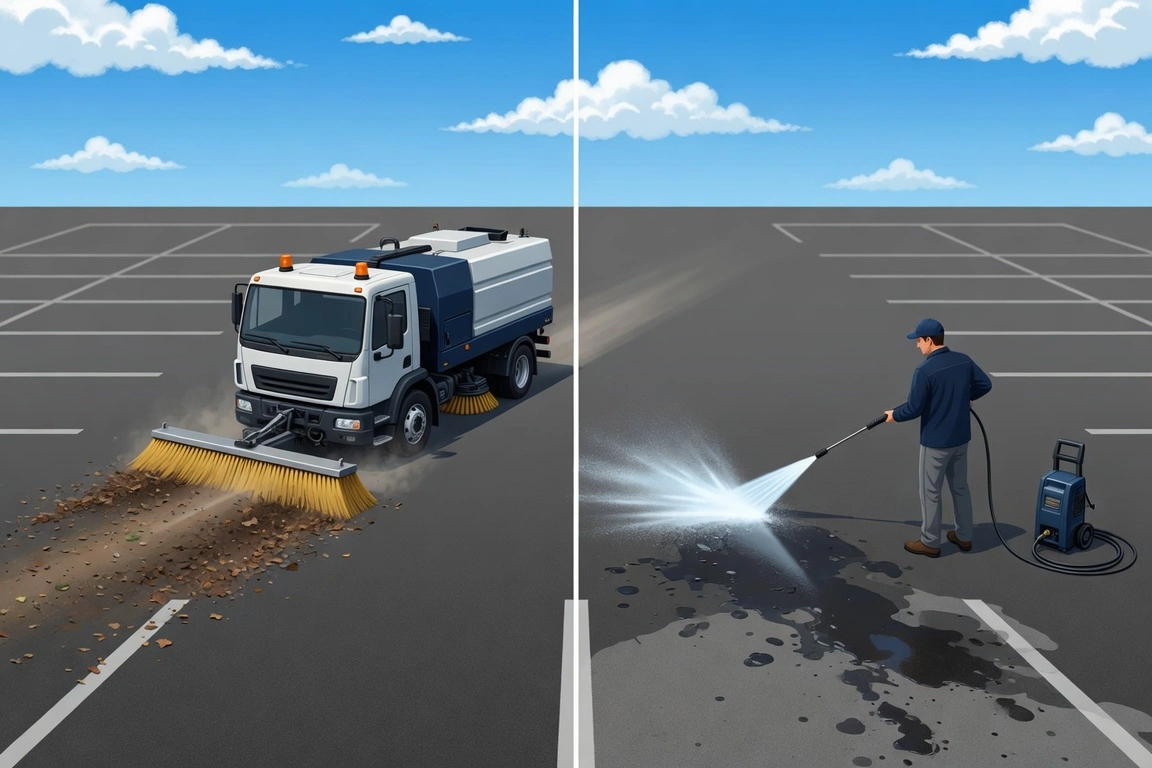
Table of Contents
- What Is the Difference Between Power Sweeping and Pressure Washing?
- When Should You Schedule Power Sweeping?
- When Does Pressure Washing Make More Sense?
- Can You Use Both? (Yes — and the Sequence Matters More Than People Think)
- What Happens If You Skip One or Both?
- How Often Should Commercial Properties Be Swept and Washed?
- FAQ
Here’s a question we get on almost every first call.
“My parking lot looks rough — do I need it swept or washed?” The caller usually expects a quick answer. What they get instead is two questions back: How long since it was last swept? And have you ever had it pressure washed at all?
The reason we ask is that power sweeping vs. pressure washing isn’t a choice between two competing services. It’s a sequencing decision. And the properties that hold up the best — year after year, through wet winters and brutal Carolina summers — are the ones whose managers understand which service to call for and when.
Carolina Sweepers has maintained commercial properties across North Carolina, South Carolina, Virginia, and Georgia for 26+ years. Here’s the same breakdown we give every new client before their first service schedule is built.
What Is the Difference Between Power Sweeping and Pressure Washing?
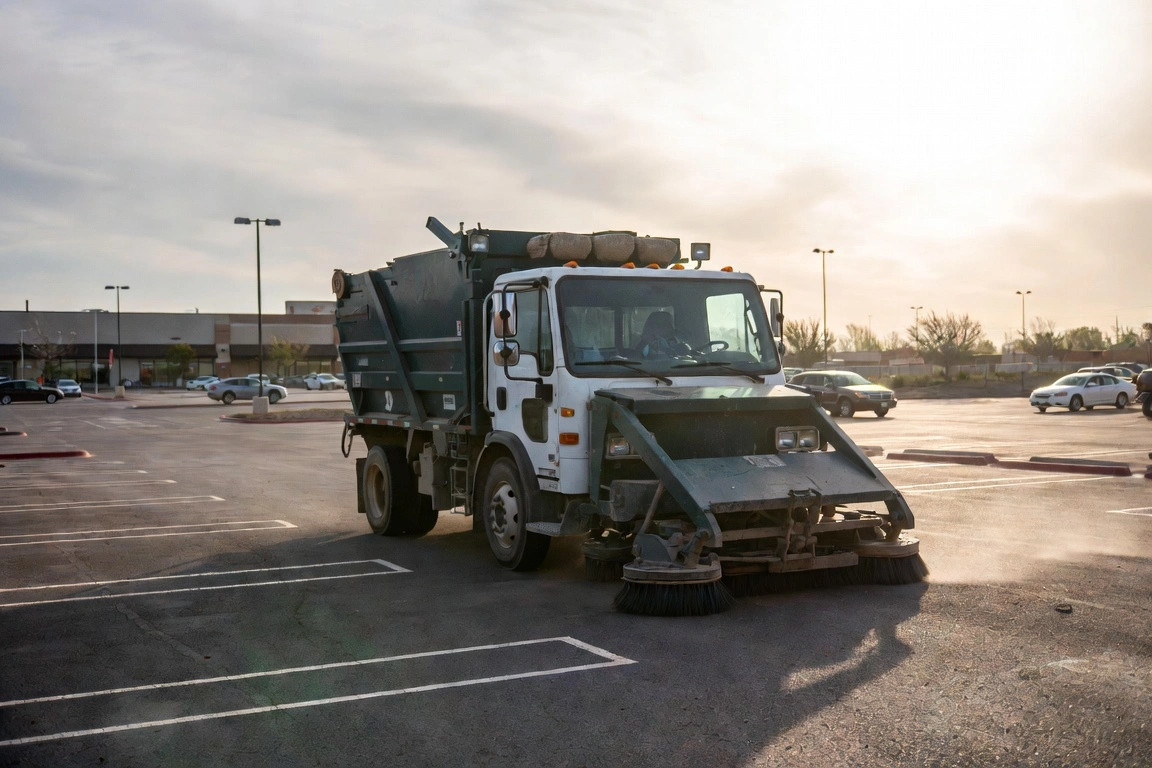
Power sweeping uses rotating brushes and industrial vacuum systems — mounted on a truck or ride-on unit — to collect loose debris from paved surfaces. Sand, gravel, litter, leaves, broken glass, sediment. It all gets collected and hauled off. Nothing gets wet. Nothing gets pushed into storm drains.
Pressure washing is different at a fundamental level. High-pressure water breaks up and flushes away embedded contamination: oil stains, tire marks, mold, mildew, algae, gum, organic buildup, chemical residue. It targets material that has bonded to the surface — the stuff that sweeping physically cannot reach.
Here’s the frame we use with clients:
- Sweeping removes what’s sitting on your pavement
- Pressure washing removes what’s been ground into your pavement
Think of it this way. You wouldn’t run a vacuum over a carpet with a deep stain and call it clean — and you wouldn’t scrub carpet that just needs vacuuming. Same exact logic on pavement.
The National Pavement Sweeping Association (NAPSA) is consistent on this: combining mechanical sweeping with periodic pressure washing measurably extends pavement lifespan. Both forms of surface contamination degrade pavement — just through different mechanisms, on different timelines.
When Should You Schedule Power Sweeping?
Regular. Recurring. Non-negotiable.
Sweeping is not a one-time fix — it’s ongoing maintenance, the same way you change oil on a schedule whether or not the engine is knocking. Here’s when it earns its keep the most.
After storms and wind events. Debris accumulates fast: branches, leaves, sand, sediment, and everything the wind pushed in from the street. Left on the surface, that material grinds into the pavement with every vehicle pass and creates slip-and-fall conditions that your insurance carrier has opinions about.
Weekly or bi-weekly for high-traffic properties. Retail centers, shopping plazas, apartment complexes, industrial facilities — these generate continuous debris. A weekly or bi-weekly sweep keeps accumulation from becoming a problem before it becomes a headline.
Before major events or tenant move-ins. Your new tenant’s first impression of the property is the parking lot. One sweep the day before costs almost nothing. The reputational cost of a debris-covered entrance costs considerably more.
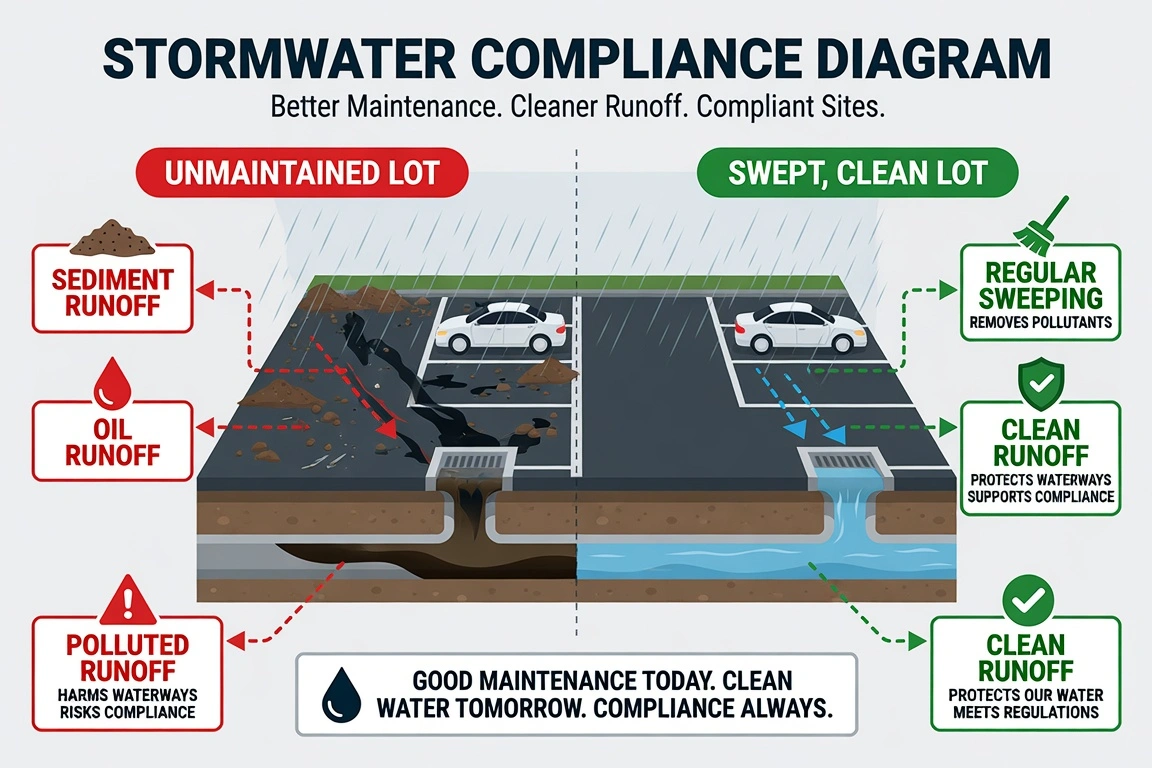
For stormwater compliance — and this is the one managers most often underestimate. Municipal stormwater ordinances across NC, SC, VA, and GA require commercial property owners to prevent sediment and pollutants from entering storm drains. The EPA’s NPDES program holds property owners accountable for what runs off their lots. Regular sweeping is cited as a Best Management Practice (BMP) in every state we operate in.
Carolina Sweepers’ Parking Lot Sweeping service runs on schedules from nightly to monthly, depending on your property type, traffic volume, and local compliance requirements. We handle the routing, the scheduling, and the disposal.
When Does Pressure Washing Make More Sense?
When the problem isn’t on the surface — it’s in it.
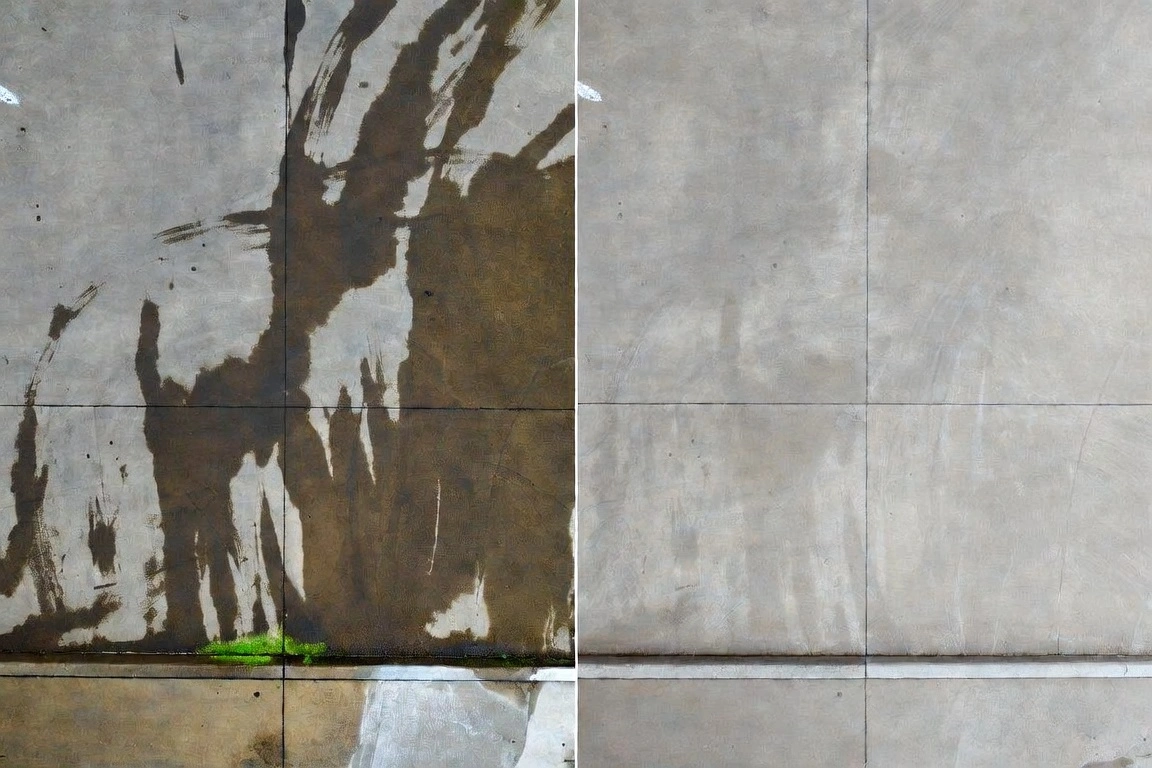
Oil and fluid stains. Every parking lot accumulates oil drips, transmission fluid, and coolant. These don’t sweep away. They bond to asphalt and concrete, attract additional contamination, and — if they reach storm drains during rain events — create environmental liability that’s expensive to explain to a municipal inspector. Pressure washing with the right commercial detergent breaks down petroleum-based stains that no brush will touch.
Mold, mildew, and algae. Shaded sections of parking decks, sidewalks, and building entrances develop biological growth faster than most people expect — particularly in the Carolinas and Georgia, where heat and humidity are relentless from May through September. That greenish film near the covered walkway isn’t just ugly. It’s a slip hazard, and slip-and-fall claims are the kind of event that ends vendor relationships and triggers property management reviews.
Tenant turnovers. When a major tenant moves out and a new one moves in, a pressure-washed entrance, sidewalk, and loading dock sends a clear signal: this property is managed. It’s one of the cheapest ways to demonstrate facility quality to an incoming tenant before they’ve signed anything.
Annual or semi-annual deep clean. Even properties on regular sweep schedules accumulate gradual surface buildup that sweeping can’t address. A periodic pressure wash resets the surface. Think of it as the difference between daily tidying and a proper deep clean — both matter, neither replaces the other.
Carolina Sweepers’ Pressure Washing service handles commercial-scale surfaces: parking lots, loading docks, building exteriors, sidewalks, and dumpster enclosures. Commercial-grade equipment, calibrated to the surface — not a contractor showing up with a consumer machine from the hardware store.
Can You Use Both? (Yes — and the Sequence Matters More Than People Think)
Not only can you run both services — in 26 years, we’ve never seen a well-maintained commercial property that relied on just one.
And the order is not optional.
Always sweep before you wash. Pressure washing a debris-covered surface pushes loose material into cracks, joints, and storm drains instead of collecting it. You’re making the wash less effective and creating the exact stormwater problem you were trying to avoid. Sweep first. Wash second. Every time.
This is the sequence we build into bundled service programs for high-traffic retail and industrial clients. A quarterly sweep-and-wash cycle keeps the surface in top condition without over-servicing either side.
We learned this the hard way on a few early jobs, honestly. There was a stretch where we’d take a pressure washing contract without asking whether the lot had been swept recently. The wash would go fine, but the crew would flag debris pushed into the expansion joints — avoidable if the sweep had come first. It’s a small thing operationally, but it’s the kind of detail that separates a property that looks good for six months from one that holds up for six years.
A mid-size retail center in Cary, NC came to us after their previous vendor had been sweeping the lot consistently but never once washing it. Two years in, oil stains had penetrated the asphalt, algae had taken hold near the main entrance, and a tenant had filed a slip-and-fall incident report. One deep pressure wash followed by a bi-weekly sweep schedule resolved the surface issues and the compliance gap within 60 days.
Bundled service clients save up to 30% compared to booking sweep and wash separately. Carolina Sweepers also offers Seasonal Services and a dedicated Storm Water Division — so stormwater compliance, surface condition, and curb appeal all stay managed under one contract.
What Happens If You Skip One or Both?
The damage is real. And it compounds quietly, which is what makes it expensive.
Skip sweeping and sand, grit, and debris grind into your pavement surface with every vehicle pass. NAPSA estimates that regular mechanical sweeping can extend pavement life by 30-50% — purely by removing the abrasive material that breaks the surface down from above. Skip it long enough and you’re accelerating toward resurfacing, not avoiding it.
Skip pressure washing and oil penetration weakens asphalt binder over time, accelerating cracking and pothole formation. Organic growth on walking surfaces creates slip hazards well-documented in insurance claims. And contaminated stormwater runoff is a compliance issue that doesn’t announce itself until there’s a notice from the municipality.
Skip both. A 50,000-square-foot commercial lot costs $75,000–$200,000 to resurface, depending on condition, market, and scope. The combined annual cost of regular sweeping and quarterly pressure washing is a fraction of that number. The math is not complicated.
Maintenance is cheap. Deferred maintenance is a capital project.
How Often Should Commercial Properties Be Swept and Washed?
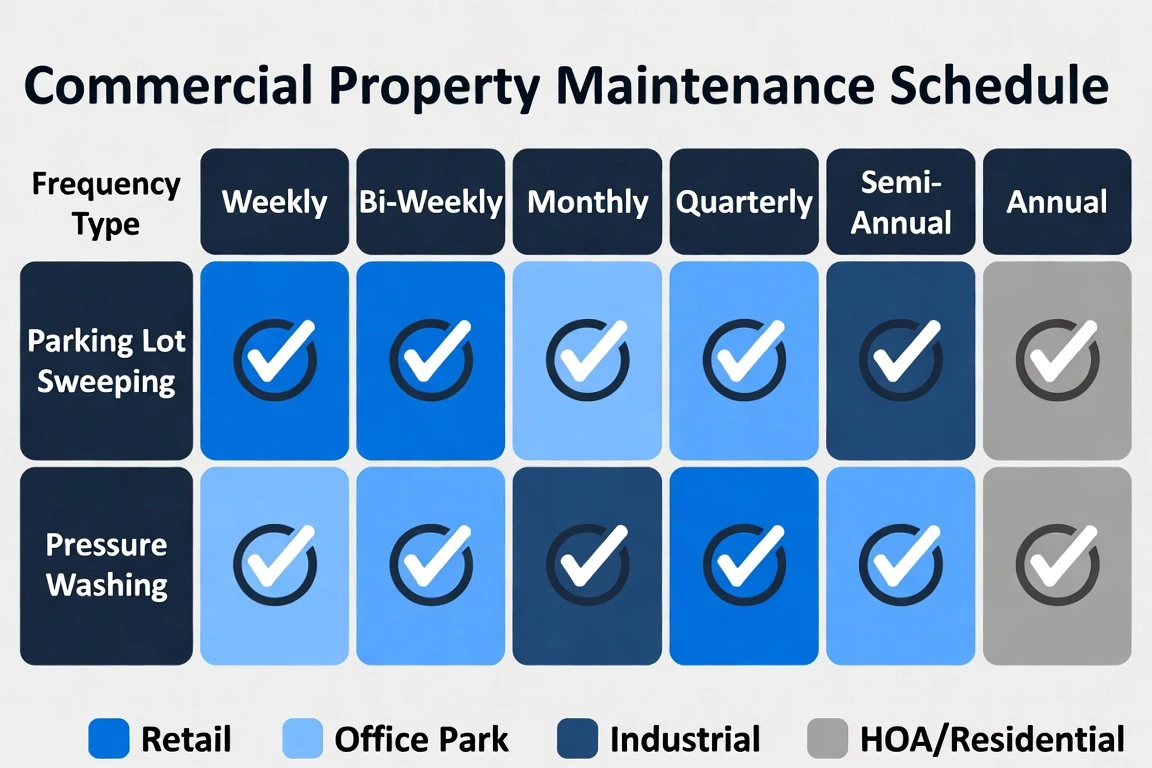
No universal answer exists — frequency depends on property type, traffic volume, surrounding environment, and local compliance requirements. Here’s a working framework:
Parking Lot Sweeping — by property type:
- High-traffic retail / shopping centers: Weekly or bi-weekly
- Office parks and corporate campuses: Bi-weekly to monthly
- Industrial facilities and distribution centers: Weekly (often nightly for active facilities)
- Apartment complexes and HOAs: Bi-weekly to monthly
- Municipal and government facilities: Per local compliance schedule
Pressure Washing — recommended frequency:
- High-traffic retail / food service adjacent: Semi-annually (spring + fall)
- Standard commercial lots: Annually minimum; semi-annually recommended
- Parking decks and covered structures: Annually, timed after heavy-use seasons
- Building entrances and sidewalks: Quarterly for high-visibility properties
Seasonality matters too. Spring cleanups after winter grit and salt accumulation are a standard event for most Carolina Sweepers clients. Fall cleanups before the wet season sets in are equally important — especially in the Piedmont and coastal markets where drainage issues compound fast once temperatures drop.
The fastest path to a real schedule is a site walk. A Carolina Sweepers team member visits the property, looks at the actual surface conditions, and recommends a program based on what’s there — not a generic quote off square footage alone.
Conclusion
Two services. Different problems. Same pavement.
Properties that hold their value, pass inspections, and avoid the expensive surprises are the ones on a real maintenance program — not the ones that call for help after the damage is visible.
If you’re not sure where your lot stands, contact us for a free site assessment. We’ll walk the property, tell you what it needs, and give you a schedule that makes sense — before a slip-and-fall report or a stormwater notice does it for you.
FAQ
What is the main difference between power sweeping and pressure washing?
Power sweeping uses industrial brushes and vacuum systems to collect loose debris — litter, sand, sediment, gravel. Pressure washing uses high-pressure water to remove embedded stains, oil, mold, and biological buildup bonded to the surface. Sweeping removes what’s on your pavement; pressure washing removes what’s in it.
How often should a commercial parking lot be swept?
High-traffic properties — retail centers, shopping plazas, industrial facilities — typically need weekly or bi-weekly sweeping. Office parks and HOAs often do well on a bi-weekly to monthly schedule. The right frequency depends on traffic volume, environment, and local stormwater compliance requirements.
Can pressure washing damage asphalt or concrete?
Improper pressure washing — wrong PSI, wrong nozzle angle, washing already-cracked surfaces — can accelerate damage. Professional commercial pressure washing uses equipment calibrated for the specific surface. Carolina Sweepers adjusts pressure and detergent based on whether the surface is asphalt, concrete, pavers, or a parking deck structure.
Does sweeping help with stormwater compliance?
Yes. Regular mechanical sweeping is recognized as a Best Management Practice (BMP) under EPA NPDES stormwater regulations across NC, SC, VA, and GA. Removing sediment and debris before rain events reduces the pollutant load entering storm drains — which is exactly what municipal compliance programs require.
Is it better to sweep or pressure wash first?
Always sweep first. Pressure washing a debris-covered surface pushes loose material into cracks, joints, and storm drains instead of collecting it. The correct order: sweep to collect loose debris, then wash to remove embedded contamination.
How much does commercial parking lot sweeping cost?
Cost varies by lot size, access complexity, frequency, and market. Bundled maintenance contracts are significantly more cost-effective than one-off services — Carolina Sweepers clients on combined programs save up to 30% compared to booking each service separately. A site assessment gives you an accurate quote based on your specific property, not a square-footage estimate.
What types of properties does Carolina Sweepers service?
Retail centers, shopping plazas, office parks, industrial facilities, distribution centers, apartment complexes, HOAs, municipal properties, and multi-location portfolios across NC, SC, VA, and GA. With 100+ trucks and 26+ years of operation, Carolina Sweepers handles everything from single-property contracts to full multi-site portfolio programs.
No Comments yet!