 Serving NC, SC, VA & GA — 26 Years of Experience, Comprehensive Maintenance Services, Multi-Location Support
A research campus in RTP doesn’t close for weather the way a school district does. Neither does a Durham medical office building with patients on the schedule, or a Raleigh retail center with a lease that doesn’t pause for ice. When a winter system moves through the Triangle (and it doesn’t happen often, which is exactly the problem), property managers are the ones left explaining to tenants why the lot wasn’t treated by 7 AM.
Carolina Sweepers has maintained commercial properties across the Triangle since 2000, and the pattern in winter service calls is consistent: properties that had a plan before the forecast showed snow came through fine. Properties that didn’t spend the morning fielding complaints instead of running their business. This article walks through what actually separates those two outcomes.
Key Takeaway: Research Triangle winter storms are infrequent but fast-moving, which means commercial properties need a contract-based response plan in place before the season starts, not a phone call made after the first flake falls. The properties that come through a storm cleanly are the ones with a defined trigger, a vendor with real equipment capacity, and documentation that protects them if something goes wrong.
Table of Contents
- Why Research Triangle Winter Storms Are Harder to Plan For Than They Look
- What’s Different About RTP, Raleigh, and Durham Properties?
- How Do You Know When to Activate Your Snow Response?
- What Should Be in a Research Triangle Winter Service Contract?
- How Does Carolina Sweepers Prepare Research Triangle Properties for Winter?
- What Should You Have Ready Before the First Freeze?
- What Carolina Sweepers Sees on Triangle-Area Properties
- Frequently Asked Questions
- Get Ahead of the Next Research Triangle Winter Storm
Why Research Triangle Winter Storms Are Harder to Plan For Than They Look
Here’s the part that surprises a lot of property managers: the Triangle’s low storm frequency is the actual risk factor, not a reason to relax. A market that sees real winter weather every year builds infrastructure around it: pre-positioned salt, standing contracts, crews who’ve done this a hundred times. Raleigh and Durham see a handful of events most winters, sometimes fewer, according to records from the State Climate Office of North Carolina, and that means the system has to reassemble itself every time instead of just running.
There’s also a geography problem specific to central North Carolina. The Triangle sits far enough inland to avoid a lot of coastal moisture, but close enough to the mountains and cold air masses that a single system can flip between snow, sleet, and freezing rain within the same 12 hours. A storm that starts as snow at 2 AM can be laying down ice by sunrise. And ice is the harder problem, because it’s less visible and it forms on surfaces that never had snow on them to begin with.
The properties most exposed aren’t always the ones you’d expect. It’s not the big corporate campuses with in-house facilities staff. It’s the mid-size office parks, the medical buildings with early patient arrivals, the HOA common areas where residents leave for work before sunrise, and the retail strips where a tenant’s lease doesn’t care whether the parking lot is safe to walk across.
What’s Different About RTP, Raleigh, and Durham Properties?
Research Triangle Park itself has a wrinkle that a lot of generic winter-prep advice misses: it’s not a retail market, it’s a research and corporate campus market. Lab facilities, biotech operations, and corporate R&D buildings often run shift-based schedules, with people arriving well before a typical 9-to-5, sometimes around the clock. A property that only clears its main visitor entrance and ignores the employee lot and loading dock has solved the wrong problem.
Durham’s medical district carries its own version of this. A clinic or outpatient building with early patient check-ins can’t treat a parking lot the way an office building treats its own. Patients walking from car to door are a different liability profile than employees who know to expect ice.
Raleigh’s retail and mixed-use corridors look more like what most people picture when they think “commercial snow removal,” but even there, the traffic pattern matters. A grocery-anchored center needs the customer-facing lanes clear first. An HOA needs the roads and walkways residents actually use before 7 AM, not the areas that look worst in a drive-by.
How Do You Know When to Activate Your Snow Response?
The single most useful thing a property manager can put in place before winter is a snow trigger: a defined accumulation or forecast threshold that automatically activates your vendor, no phone call required. Many commercial contracts use a 1-inch trigger; properties with early arrivals (medical buildings, research campuses running early shifts) often set it lower, at a half inch.
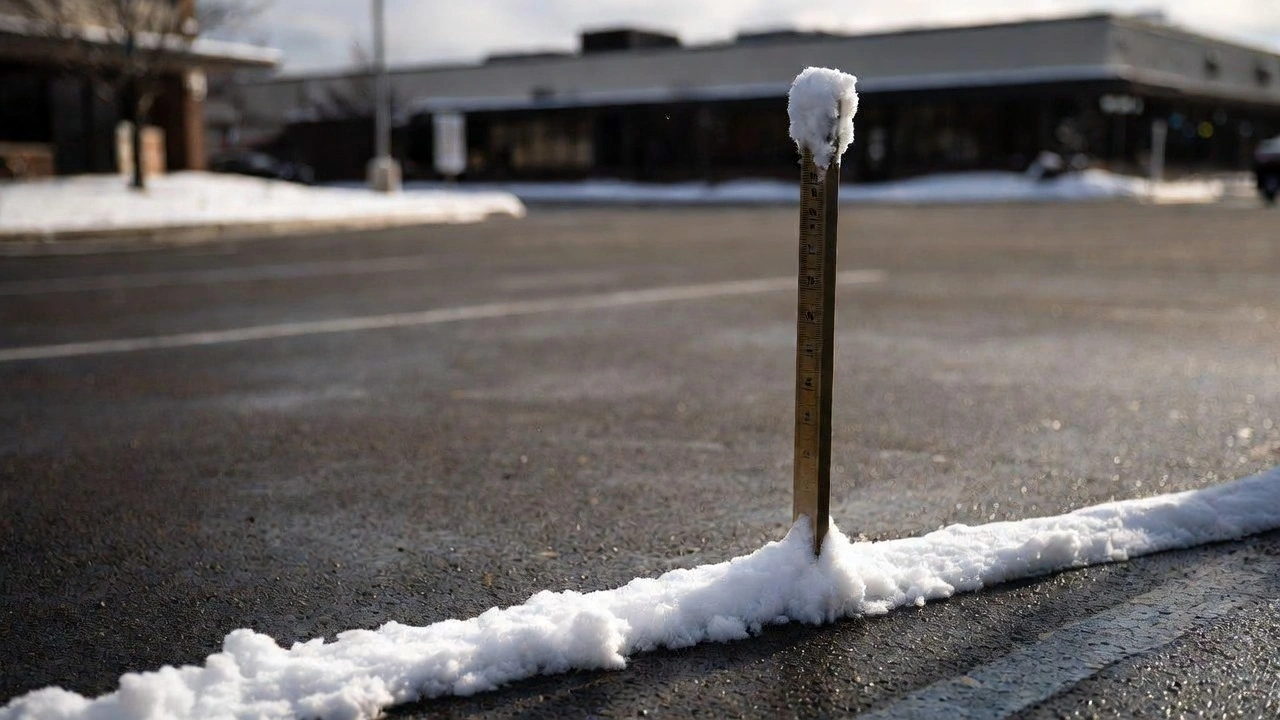
Without a trigger, the response depends on someone noticing the weather, deciding it’s bad enough, and reaching a vendor at 4 AM. That chain breaks in predictable places: the vendor’s already committed elsewhere, the facilities contact doesn’t answer, or the storm outpaces whoever’s watching it. A trigger removes the judgment call from the moment it matters least.
When you’re reviewing a contract, look for specifics, not general language (our guide to what to expect from a professional snow service in Raleigh covers more):
- The trigger threshold, stated in inches
- How fast crews arrive once the trigger’s met
- Whether the contractor re-services overnight if the event keeps going
- Whether de-icing and salting are included or billed separately
- Where your property sits in the queue if the vendor has other clients that morning
That last point matters more here than in markets with deep bench capacity. Snow work in the Triangle is handled by a mix of providers, from full-time winter operations to seasonal crews, so ask about your vendor’s total fleet size and how many other properties share it before you’re depending on it.
What Should Be in a Research Triangle Winter Service Contract?
Beyond the trigger, a real winter contract should spell out documentation: time-stamped service records, material logs showing how much salt or de-icer went down and where, and photo evidence before and after the visit. This isn’t paperwork for its own sake. If a tenant’s employee or a patient slips at 7 AM, “someone came out at 4 AM” won’t hold up well with your insurance carrier. What was applied, where, and when: that’s the answer that holds up.
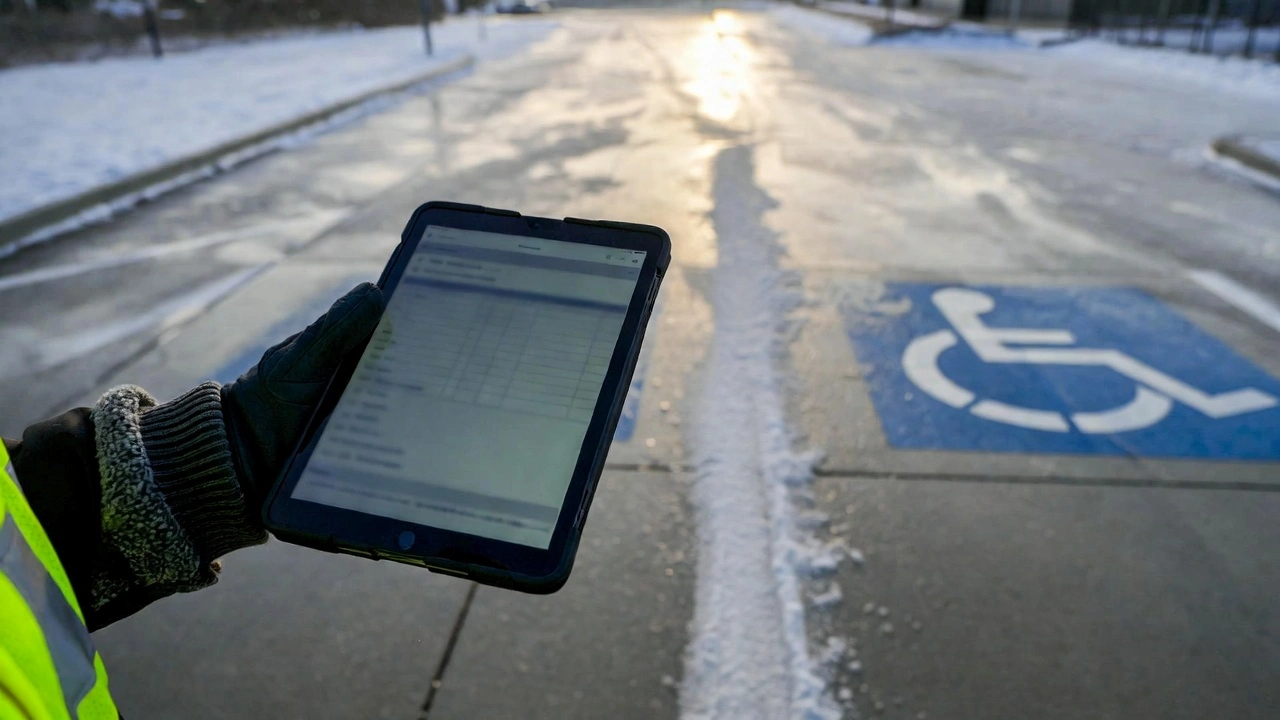
Ice deserves specific mention here, because it’s the hazard Triangle storms produce more reliably than snow does. A freezing rain event can leave a walkway with a glaze that’s almost impossible to see, especially before sunrise. Contracts should name walkways, drive aisles, loading docks, and any transition point between paved and unpaved surfaces. Accessible routes aren’t optional line items, since federal rules require businesses to maintain accessible features in working condition. NWS Raleigh’s winter preparedness page covers how quickly these conditions can develop in central North Carolina, and it’s worth reading once as a property manager, not just forwarding to your vendor.
How Does Carolina Sweepers Prepare Research Triangle Properties for Winter?
When we take on winter service for a Triangle property, it starts with a walk-through before any weather is in the forecast, not after. We’re looking at drainage points, slope, where entry and exit lanes bottleneck, and which areas hold water and refreeze fastest. That walk-through is what tells a crew where to start and how much material to pre-stage, instead of guessing at 3 AM.
Our fleet of 100+ trucks gives us same-night response capacity across our contracted properties. When a system hits the Triangle and the Charlotte metro at the same time (which happens more than people expect), we have the equipment to cover both markets rather than stretching one crew across them. Properties under contract with us get a call if conditions shift mid-event, not silence until someone checks the lot in the morning.
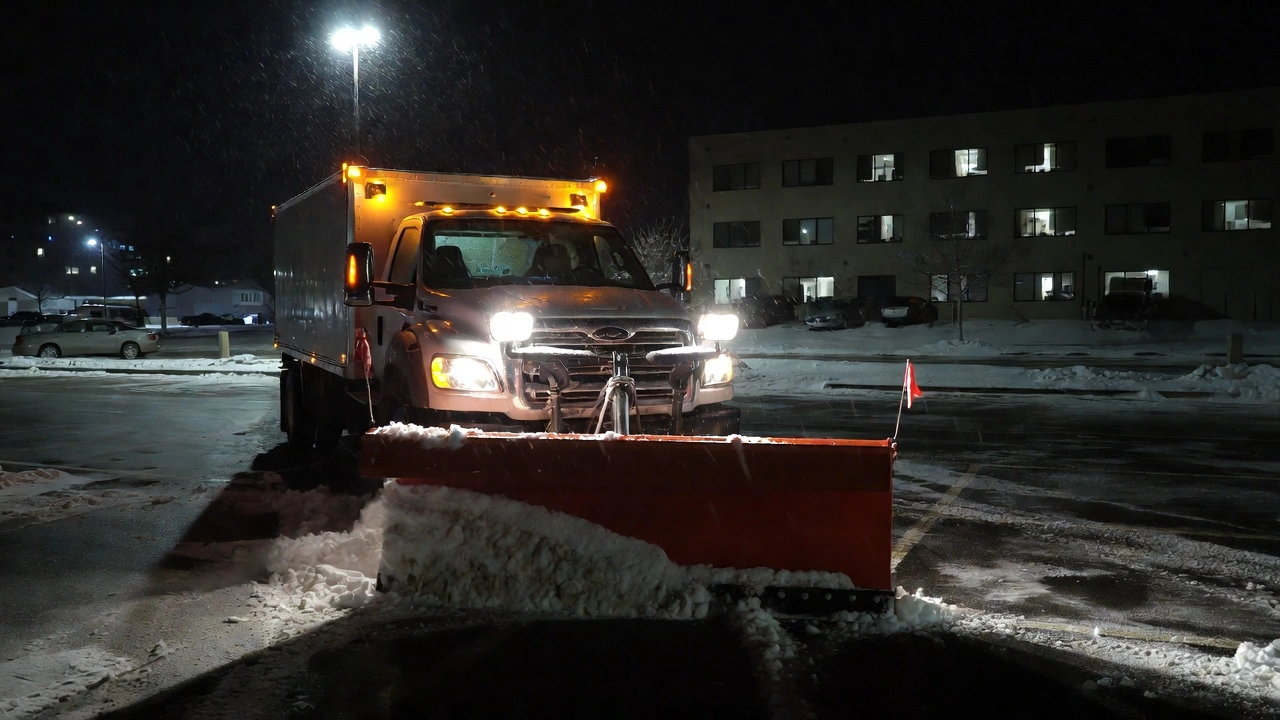
If you’re already contracting parking lot sweeping in Raleigh or another service through Carolina Sweepers, adding snow and ice removal to the same contract is usually simpler than managing a separate winter vendor. One contractor who already knows your drainage layout and traffic pattern responds faster than one meeting your property for the first time in the dark.
What Should You Have Ready Before the First Freeze?
The Triangle’s first real winter event can land anywhere from late November to February, usually with less lead time than anyone would like. Before the cold sets in, property managers should have:
- A signed contract with the trigger threshold written down, not a verbal understanding from a phone call in October
- Your vendor’s after-hours dispatch number, not just the main office line
- A short tenant communication template ready to send when a storm is forecast
- A current insurance certificate from your vendor, matching the scope of work on your property
- Confirmation of what material your vendor pre-stages specifically for your site
That last point matters because ice melt supply can tighten fast when a regional event hits several markets at once. A vendor who’s already staged product for your address is in a different position than one sourcing reactively once the trucks are already rolling.
Property managers dealing with drainage or ponding issues on top of winter prep should also take a look at the stormwater services Carolina Sweepers offers. A lot of the same low points that collect standing water in a summer storm are exactly where ice forms first in January. And if winter prep is one piece of a broader annual planning conversation, our seasonal maintenance checklist covers how it fits alongside the rest of the year.
What Carolina Sweepers Sees on Triangle-Area Properties
We’ve found that Triangle properties fall into two groups every winter: the ones who call in October to lock in a contract, and the ones who call at 11 PM during the first event asking if anyone can come out. The second group isn’t making a mistake out of carelessness. It’s that a market with infrequent storms doesn’t train anyone to think about this until the weather app shows snowflakes.
What we see most often on research campuses specifically is a mismatch between where the property manager assumes the priority should be and where the actual foot traffic is at 5 AM. A lab running a shift change at 6 doesn’t care that the visitor entrance looks clean if the employee lot and the loading dock are still glazed over. A tow-behind broadcast spreader lays down more even coverage across a large campus lot than a tailgate unit can manage, which matters when half the site is loading dock and half is visitor parking, and both need to be usable by the same hour.
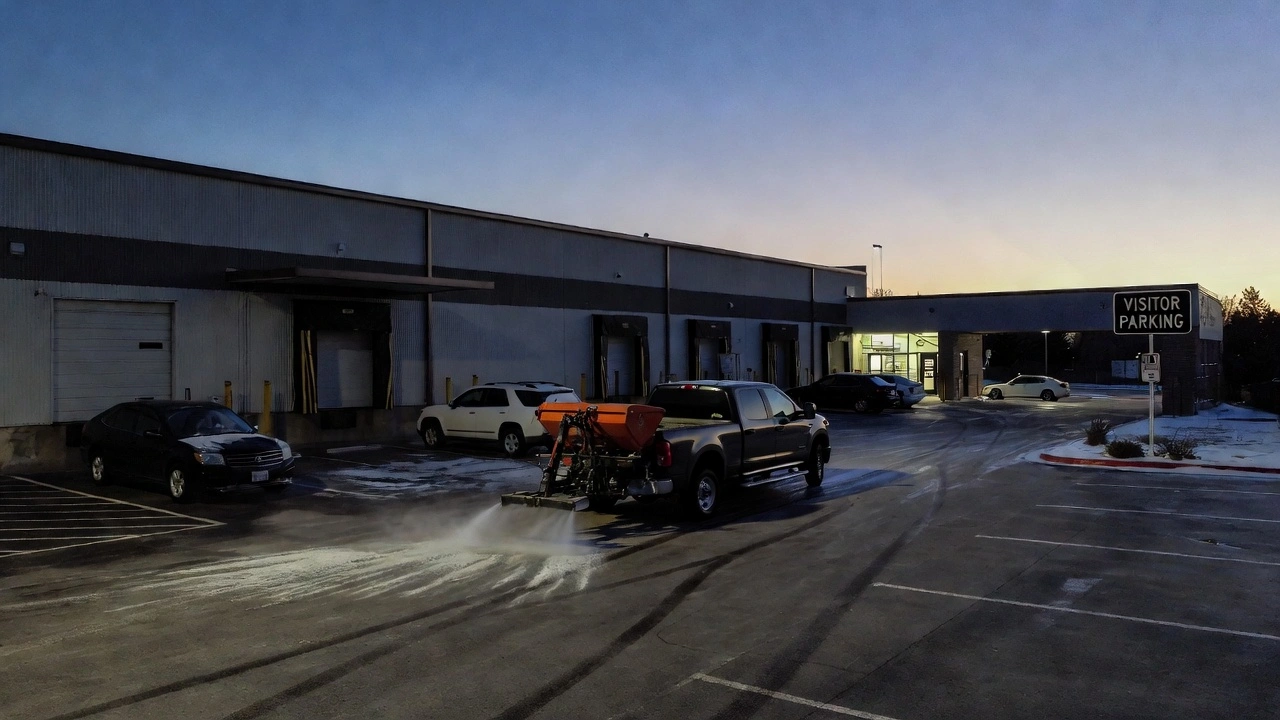
We’ve also noticed that Triangle ice events leave a distinct debris pattern once the thaw starts: sand and salt residue collecting along curb lines and low points, which is a different cleanup than what a straightforward snowfall leaves behind. Properties that bundle a post-storm sweep into their contract don’t have to think about that separately; it just happens as part of the thaw cycle.
Frequently Asked Questions
How fast can Carolina Sweepers respond to a Research Triangle property once a storm starts?
For properties under an active winter contract, same-night dispatch once your trigger threshold is met is the standard. Properties without a pre-season agreement go into a secondary queue. That’s not a penalty; contracted properties simply get priority routing when every vendor’s phone starts ringing at once.
Do research campuses in RTP need a different service plan than a typical office building?
Usually, yes. Shift-based schedules mean the employee lot and loading dock often need to be cleared as early as the visitor entrance, or earlier. This is something to define explicitly in the contract rather than assume your vendor will guess correctly.
What’s a reasonable snow trigger for a Raleigh or Durham commercial property?
A 1-inch trigger is common for most commercial sites. Medical buildings, senior living facilities, and campuses with early shift arrivals often set it at a half inch, since even a light accumulation can be hazardous before most other traffic is on the roads.
Does Carolina Sweepers handle ice-only events, or just plowable snow?
Both. Ice-only events (freezing rain with no real accumulation to plow) are actually one of the more common Triangle winter scenarios, and they’re covered under the same winter response contract as plowing and de-icing. Pre-treating with brine before the storm helps keep ice from bonding to the pavement, the same approach NCDOT uses on state roads.
Can winter service be bundled with parking lot sweeping or other services we already use?
Yes, and for most properties already working with us, it’s the simpler route. One contractor who already knows your site’s layout and drainage points responds faster than a separate winter-only vendor learning the property mid-storm. Here’s more on how single-source maintenance works.
How far in advance should a Triangle property set up winter coverage?
Ideally before the first cold snap of the season. September or October gives time for a site walk-through and trigger-threshold setup before demand spikes. If it’s already November, it’s still worth calling now: contracts signed after a storm is already in the forecast depend on whatever capacity is left.
Get Ahead of the Next Research Triangle Winter Storm
Winter in the Triangle is unpredictable by nature, but the response to it doesn’t have to be. A signed contract, a clear trigger, a vendor with real equipment capacity, and documentation that protects your property: that’s the difference between a lot that’s open by 7 AM and one that isn’t.
Carolina Sweepers serves commercial properties across Raleigh, Durham, RTP, and the broader Triangle, offering winter response, including snow plowing and ice removal in Raleigh, as a standalone contract or bundled with other property services. Call (919) 481-9003 or schedule a free walk-through before the season’s first system shows up on the forecast.
No Comments yet!