 Serving NC, SC, VA & GA — 26 Years of Experience, Comprehensive Maintenance Services, Multi-Location Support
Key Takeaway: The true dirty parking lot cost runs $10,000-$50,000+ annually in hidden expenses for commercial property managers – from slip-and-fall lawsuits averaging $30,000-$40,000 per claim to accelerated pavement failure and tenant turnover. Regular parking lot sweeping and maintenance costs 70-80% less than the reactive repairs, legal fees, and lost revenue that dirty lots generate. Carolina Sweepers helps 1,000+ commercial properties across NC, SC, VA, and GA avoid these costs with proactive maintenance programs.
Table of Contents
- How Much Does Parking Lot Neglect Actually Cost?
- Maintenance vs. Neglect: Cost Breakdown
- What Are the Slip-and-Fall Liability Risks of a Dirty Parking Lot?
- How Does Parking Lot Appearance Affect Tenant Retention and Revenue?
- What Stormwater Fines Can a Dirty Parking Lot Trigger?
- Does a Dirty Parking Lot Accelerate Pavement Damage?
- How Do Dirty Parking Lots Create ADA Compliance Risks?
- Can a Dirty Parking Lot Attract Pests and Health Hazards?
- Frequently Asked Questions
- Conclusion: The True Cost of Inaction
- Building a Proactive Maintenance Plan
- Partnering with a Professional Maintenance Provider
- Call to Action: Free Property Assessment & Quote
How Much Does Parking Lot Neglect Actually Cost?
Hidden Annual Costs of Deferred Maintenance
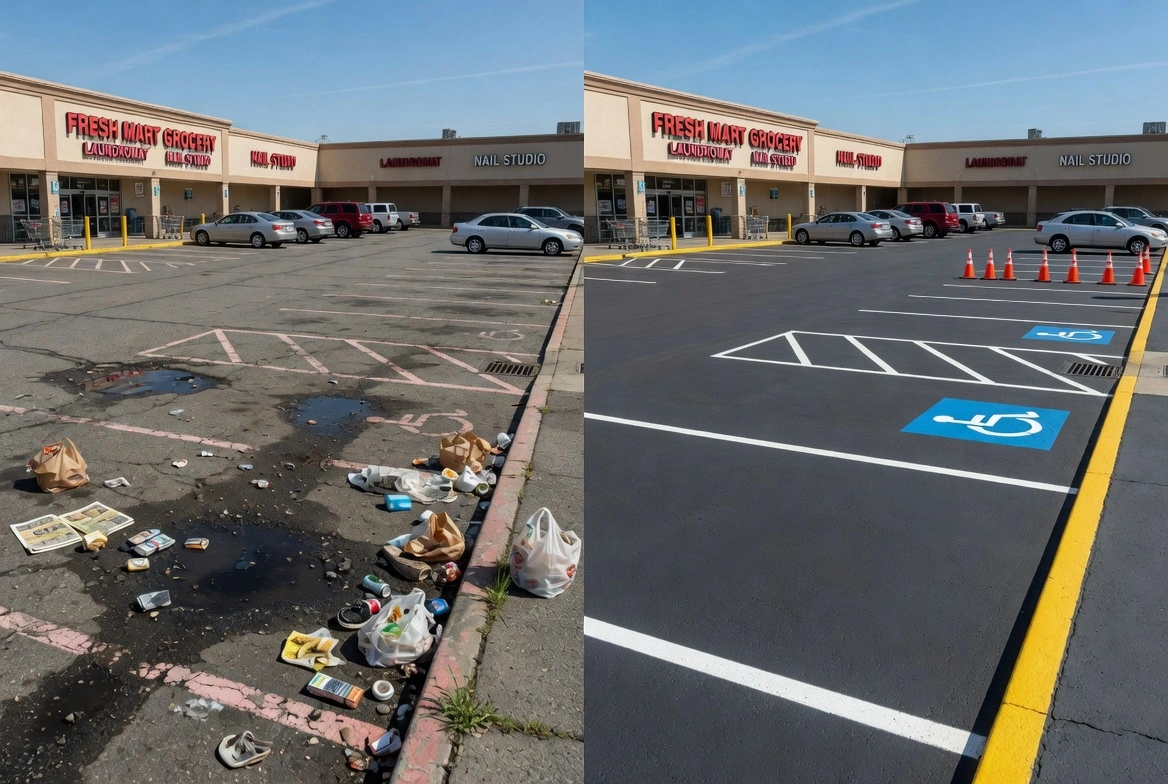
The dirty parking lot cost for the average commercial property manager runs $12,000–$25,000 per year in problems caused by deferred maintenance. Most never connect the dots. These costs scatter across budget lines: legal fees, emergency repairs, tenant concessions, and accelerated capital expenditures that nobody planned for.
Preventive vs. Reactive Maintenance Comparison
A 2023 study by the Building Owners and Managers Association (BOMA) found that reactive maintenance costs 3–5 times more than preventive programs. For a 75,000 sq ft retail parking lot, that’s $15,000–$20,000 on emergency fixes versus $3,000–$5,000 on scheduled parking lot sweeping and maintenance.
Here’s what makes it worse: the damage compounds. Each month of skipped sweeping introduces debris that clogs drains, accelerates surface wear, and creates hazards. After 6–12 months of neglect, you’re looking at a backlog of problems that require capital-level spending to resolve.
Maintenance vs. Neglect: Cost Breakdown
Annual Cost Comparison Table
| Cost Category | With Regular Maintenance | With Neglect (No Program) |
|---|---|---|
| Sweeping (weekly) | $3,600–$7,200/year | $0 (skipped) |
| Pressure washing (quarterly) | $1,200–$2,400/year | $0 (skipped) |
| Emergency drain clearing | $0–$200 | $1,500–$4,000 |
| Slip-and-fall claims | $0–$500 (insurance only) | $5,000–$40,000+ per incident |
| Pavement repair/overlay | $0–$1,000 (minor patches) | $8,000–$25,000 (accelerated failure) |
| Tenant concessions/turnover | $0 | $5,000–$15,000+ |
| Stormwater fines | $0 | $2,500–$25,000 per violation |
| Annual Total | $5,000–$11,300 | $22,000–$109,000+ |
Long-Term Financial Impact
Look at the “With Neglect” column. That’s $22,000–$109,000 in potential costs, avoided by spending $5,000–$11,000 per year on maintenance. Over a 5-year ownership window, the gap widens dramatically: properties on a maintenance program spend $25,000–$56,000, while neglected lots can rack up $110,000–$545,000 in cumulative damage, lawsuits, and accelerated capital replacement. The longer a lot goes unswept, the steeper the curve.
What Are the Slip-and-Fall Liability Risks of a Dirty Parking Lot?
Average Claim Costs
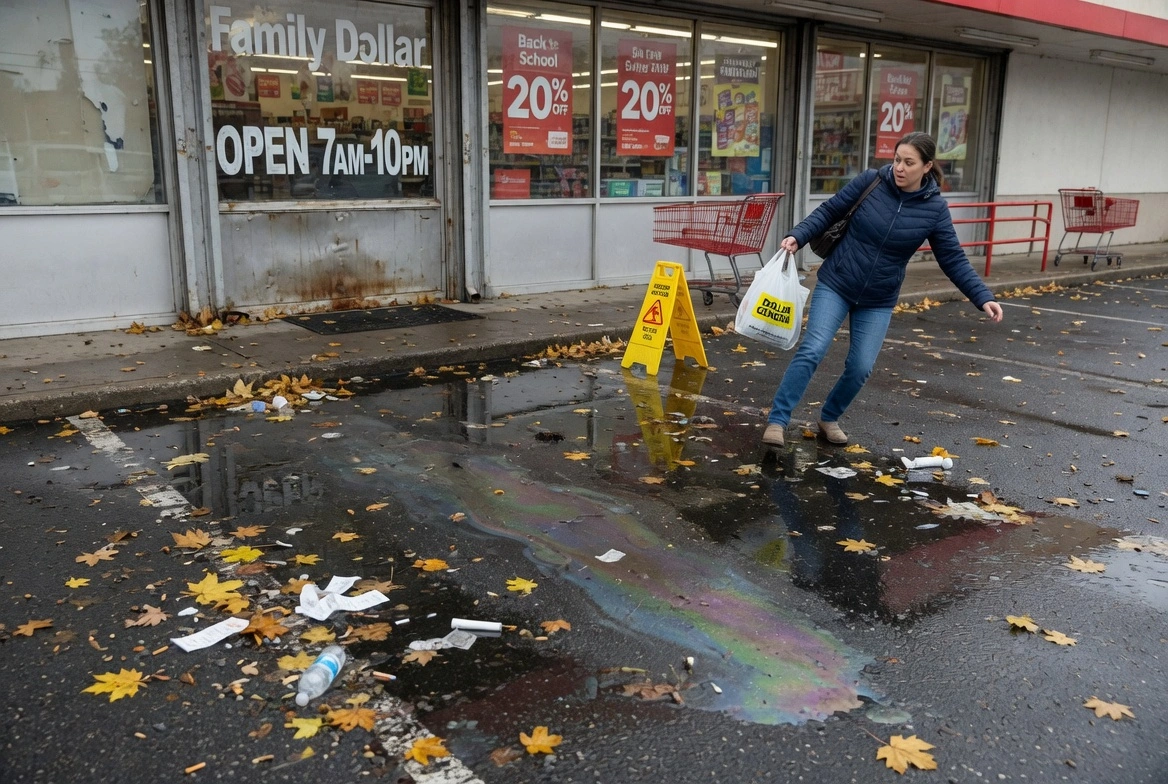
Slip-and-fall lawsuits are the single largest financial risk tied to a neglected parking lot. The average commercial claim runs $30,000–$40,000 in settlement and legal fees. The National Safety Council reports that falls account for over 8 million emergency room visits annually, and parking lots rank among the most common locations.
Southeast properties deal with 45–55 inches of annual rainfall, according to NOAA Climate Data. Rain on a debris-covered surface creates slippery conditions that a clean lot would drain safely. Regular sweeping removes the debris that turns a rainstorm into a lawsuit.
Legal Standards for Property Owners
Debris, oil residue, standing water, algae growth. They all create slip hazards. And when property managers skip regular cleaning schedules, they lose the strongest legal defense available: documented proof of reasonable care.
Courts in North Carolina, South Carolina, Virginia, and Georgia evaluate premises liability based on whether the property owner took “reasonable steps” to maintain safe conditions. A documented sweeping schedule and maintenance log demonstrates that standard. No documentation? No defense.
How Maintenance Documentation Protects You
Carolina Sweepers provides service documentation for every visit, giving property managers the paper trail they need if a claim ever arises. Date- and time-stamped reports, route logs, and photographic records turn a “he said, she said” liability case into a defensible record of routine care.
How Does Parking Lot Appearance Affect Tenant Retention and Revenue?
Impact on Lease Renewals
Tenant retention drops measurably when parking lot conditions decline. CBRE reports that exterior property appearance ranks as the third most important factor in commercial lease renewal decisions, behind only rental rate and location. Office park and industrial property managers deal with similar dynamics. Facility managers bringing prospective tenants on property tours know that first impressions start in the parking lot, not the lobby.
Customer Perception and Foot Traffic
Retail tenants feel it most directly. The International Council of Shopping Centers (ICSC) found that 52% of shoppers say parking lot condition influences whether they enter a store. Visible debris, stained surfaces, faded striping — that signals a property in decline. And tenants notice their customers noticing.
Cost of Tenant Turnover
Think about the math on losing just one tenant. For a retail center averaging $25 per square foot in rent, one vacant 2,000 sq ft space costs $50,000 in annual revenue. Replacing that tenant typically takes 6–12 months and adds another $15,000–$30,000 in broker fees, build-out allowances, and vacancy losses.
Properties maintained by Carolina Sweepers across the Triangle, Charlotte Metro, and Hampton Roads consistently present the clean, professional appearance that retains tenants and attracts new ones.
What Stormwater Fines Can a Dirty Parking Lot Trigger?
Overview of NPDES Requirements
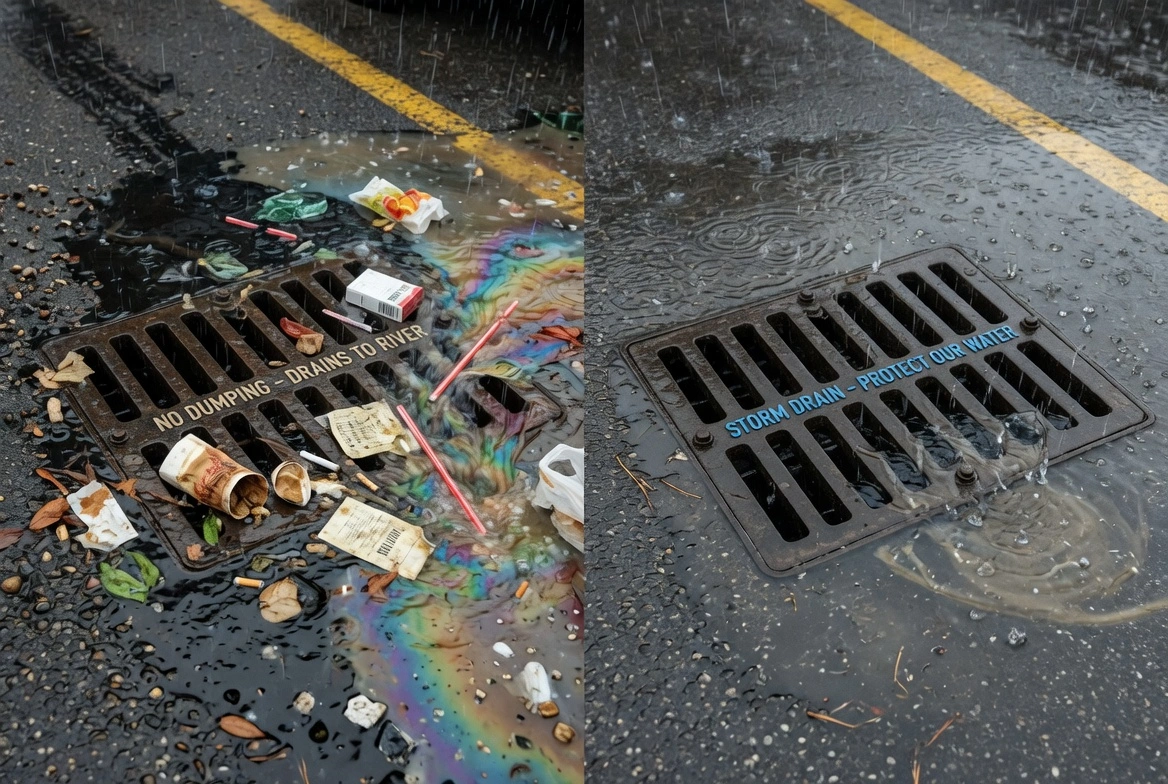
Fines of $2,500–$25,000 per day. That’s the range in most Southeast states, and a dirty parking lot is one of the most common triggers. The EPA’s National Pollutant Discharge Elimination System (NPDES) requires commercial properties to prevent pollutants, including sediment, oil, and debris, from entering storm drains.
Common Violations
North Carolina’s Department of Environmental Quality (NC DEQ) actively enforces stormwater regulations in urban areas, particularly in the Triangle, Charlotte, and Triad regions. Properties that allow debris accumulation near storm drains risk inspections, citations, and mandatory remediation.
So what counts as a pollutant? Leaves, litter, sediment, oil drippings, and chemical residue. All of it washes into drains during rainstorms and flows directly into local waterways. Regular sweeping removes these pollutants before they reach the drainage system.
Cost of Non-Compliance
The EPA classifies parking lot sweeping as a Best Management Practice (BMP) for stormwater compliance. Properties with documented sweeping schedules demonstrate compliance during inspections. Properties without them face enforcement action — and the per-day fine structure means a single missed inspection cycle can compound into five-figure penalties before remediation even begins.
Carolina Sweepers’ stormwater maintenance services cover drain cleaning, detention pond maintenance, and regular sweeping, keeping commercial properties compliant without needing to track regulations personally.
Does a Dirty Parking Lot Accelerate Pavement Damage?
How Debris Causes Surface Wear
Yes, significantly. Debris left on parking surfaces accelerates pavement deterioration by 2–3 years compared to regularly swept lots. Sand, gravel, and sediment act as abrasives under vehicle tires, grinding away sealant and surface layers with every pass. Organic debris like leaves and pollen traps moisture against the surface, promoting crack formation and frost damage.
The Asphalt Institute recommends regular sweeping as part of any pavement preservation program. Their research shows that preventive maintenance, including sweeping, sealcoating, and crack repair, extends parking lot life by 10–15 years compared to a “run to failure” approach.
Cost of Early Repairs and Resurfacing
The cost difference is stark. Resurfacing a 50,000 sq ft parking lot runs $75,000–$150,000. Extending that lot’s life by even 5 years through regular maintenance saves the property owner $15,000–$30,000 annually in deferred capital expenditure.
Asphalt repair becomes necessary sooner when debris grinds into surface cracks. Potholes form when water infiltrates these cracks and expands during freeze-thaw cycles, which still occur 15–25 times per winter across North Carolina and Virginia.
Impact on Striping and Maintenance Cycles
And then there’s your lot striping. Debris abrasion wears paint faster, requiring re-striping every 12–18 months instead of the standard 24–36 month cycle. That doubles your striping budget for no reason other than skipped sweeping.
How Do Dirty Parking Lots Create ADA Compliance Risks?
Accessibility Requirements
Americans with Disabilities Act (ADA) compliance requires accessible routes to be maintained free of obstructions and hazards. A dirty parking lot can violate this standard in ways most managers don’t think about. Debris accumulation in accessible parking spaces, curb ramps, and pedestrian routes creates real barriers for wheelchair users and people with mobility impairments.
Common Violations
Common ADA violations caused by parking lot neglect include:
- Debris blocking accessible parking spaces or access aisles
- Sediment buildup on curb ramps creating uneven surfaces
- Faded or missing handicap striping and signage
- Standing water in accessible routes due to clogged drains
- Cracked or uneven pavement in accessible pathways
Legal and Financial Consequences
The Department of Justice ADA enforcement can pursue complaints from any visitor who encounters inaccessible conditions. Settlements and judgments for ADA parking lot violations typically range from $5,000–$75,000, depending on the scope of non-compliance and whether the property has prior violations.
Regular sweeping, pressure washing, and surface maintenance keep accessible areas clear and compliant. Property managers who bundle these services through Carolina Sweepers maintain ADA compliance as a byproduct of their regular maintenance program, no separate accessibility audit required.
Can a Dirty Parking Lot Attract Pests and Health Hazards?
Rodents, Insects, and Standing Water Risks
Absolutely. Food waste, standing water, and organic debris in neglected parking lots attract rodents, insects, and birds that create health and property damage concerns. The Centers for Disease Control and Prevention (CDC) identifies standing water in commercial areas as a breeding ground for mosquitoes carrying West Nile virus and Eastern equine encephalitis, both present in the Southeast.
Rodents follow food waste. Retail center parking lots that go unswept allow food containers, wrappers, and organic waste to pile up near dumpster areas and building entries. Once rodent populations establish near a commercial property, they damage vehicles, chew electrical wiring, and eventually find their way into tenant spaces.
Health and Property Damage Concerns
Birds are another problem. Pigeon and starling droppings are acidic enough to damage vehicle paint and building surfaces, and they carry histoplasmosis and other respiratory pathogens. Properties with abundant ground-level food sources become roosting magnets.
For property managers in humid Southeast markets like Charlotte, Atlanta, Charleston, and the Hampton Roads area, pest pressure is already elevated by climate. A dirty parking lot is basically an open invitation. Regular sweeping removes the food sources and standing water that attract pests. Properties on weekly sweeping schedules rarely develop pest problems originating from parking areas.
Frequently Asked Questions
How often should a commercial parking lot be swept?
Most commercial parking lots should be swept weekly at minimum. High-traffic retail centers and properties with restaurants benefit from 2–3 sweeps per week. Properties near construction sites, wooded areas, or heavy-traffic roads may need increased frequency seasonally. Annual contracts typically reduce per-visit costs by 15–25%.
What is the average cost of parking lot sweeping?
Commercial parking lot sweeping costs $75–$300 per visit depending on lot size, debris level, and frequency. A standard 50,000 sq ft retail lot in the Southeast typically costs $100–$175 per weekly sweep. Annual contracts for weekly service range from $4,000–$9,000, significantly less than the cost of problems caused by skipping maintenance.
Can I be sued if someone falls in my parking lot?
Yes. Property owners and managers have a legal duty to maintain reasonably safe conditions. Slip-and-fall claims on commercial properties average $30,000–$40,000 in settlements and legal costs. Documented maintenance records showing regular sweeping and hazard removal provide the strongest defense against premises liability claims.
Does parking lot sweeping really prevent stormwater fines?
The EPA classifies regular parking lot sweeping as a Best Management Practice (BMP) for stormwater compliance. Properties with documented sweeping schedules demonstrate proactive pollutant prevention during inspections. Stormwater violations carry fines of $2,500–$25,000 per day in most Southeast states, making regular sweeping a cost-effective compliance strategy.
How does a dirty parking lot affect property value?
Commercial appraisers factor exterior condition into property valuations. Neglected parking lots with visible deterioration, staining, and debris can reduce appraised values by 5–10%. Over a 10-year ownership period, this translates to $50,000–$500,000 in lost value for mid-size commercial properties, depending on market.
What should I include in a parking lot maintenance contract?
A solid contract should cover regular sweeping (weekly minimum), quarterly pressure washing, annual sealcoating or as-needed crack repair, seasonal adjustments for pollen and leaf seasons, storm drain clearing, and line striping on a 24–36 month cycle. Bundled contracts from a single provider like Carolina Sweepers save up to 30% compared to separate vendors.
Is night sweeping better than daytime sweeping?
Night sweeping works best for retail centers and properties where daytime sweeping would disrupt customer traffic. It allows thorough cleaning of the entire lot without working around parked vehicles. Most Carolina Sweepers retail clients schedule sweeping between 10 p.m. and 6 a.m. for minimal disruption and maximum coverage.
How do I know if my parking lot needs immediate attention?
Warning signs include visible debris accumulation, standing water after rain, oil stains spreading beyond 12 inches in diameter, potholes deeper than 1 inch, faded striping that’s difficult to see at night, and complaints from tenants or customers about lot condition. If you spot two or more of these signs, schedule a professional assessment immediately.
Conclusion: The True Cost of Inaction

Why Costs Compound Over Time
Every week you defer maintenance, the dirty parking lot cost grows — liability exposure increases, pavement deterioration accelerates, and the property appearance that keeps tenants renewing leases erodes a little more. These costs compound, and they always exceed what regular maintenance would have cost.
Preventive Maintenance ROI
The fix is straightforward. A scheduled maintenance program covering weekly sweeping, quarterly pressure washing, and proactive stormwater management costs a fraction of the problems it prevents. For most mid-size commercial properties, that’s $5,000–$11,000 per year to avoid $22,000–$109,000 in potential losses — a 4–10x return on every maintenance dollar spent.
Building a Proactive Maintenance Plan
Key Services to Include
A complete maintenance plan covers the full lifecycle of a commercial parking lot, not just sweeping in isolation. The core services every plan should include:
- Weekly parking lot sweeping with documented service reports
- Quarterly pressure washing for entries, walkways, and high-stain areas
- Routine drain cleaning and stormwater compliance checks
- Asphalt repair, sealcoating, and line striping on a 24–36 month cycle
- Seasonal adjustments for pollen, leaf-fall, and winter debris loads
Benefits of Bundled Solutions
Bundling these services with one provider produces measurable savings. A single contract eliminates the coordination overhead of managing 3–5 separate vendors, reduces per-service pricing by 20–30%, and ensures every visit produces unified documentation that supports both insurance defense and stormwater compliance reporting. Bundled clients also get the consistency of a single crew that knows the property — issues get spotted earlier, before they escalate into capital expenses.
Partnering with a Professional Maintenance Provider
Efficiency and Cost Savings
Carolina Sweepers has maintained 1,000+ commercial properties across NC, SC, VA, and GA for 26+ years, with a 98% annual client retention rate. The bundled service approach saves property managers up to 30% compared to using separate sweeping, washing, and pavement vendors — and the operational efficiency of a single dispatch system means faster response on emergencies and weather events.
Simplified Property Management
One vendor, one invoice, one point of contact, one service log per property. Property managers running 5, 10, or 50+ sites cut hours of coordination work every month when sweeping, pressure washing, stormwater, and pavement maintenance all flow through a single account team. That time goes back into tenant relationships and capital planning instead of vendor wrangling.
Call to Action: Free Property Assessment & Quote
Ready to see what your parking lot is really costing you? Contact Carolina Sweepers for a free property assessment and maintenance quote. We’ll walk your property, identify the risks, and build a program that protects your investment, starting with one call.
No Comments yet!