 Serving NC, SC, VA & GA — 26 Years of Experience, Comprehensive Maintenance Services, Multi-Location Support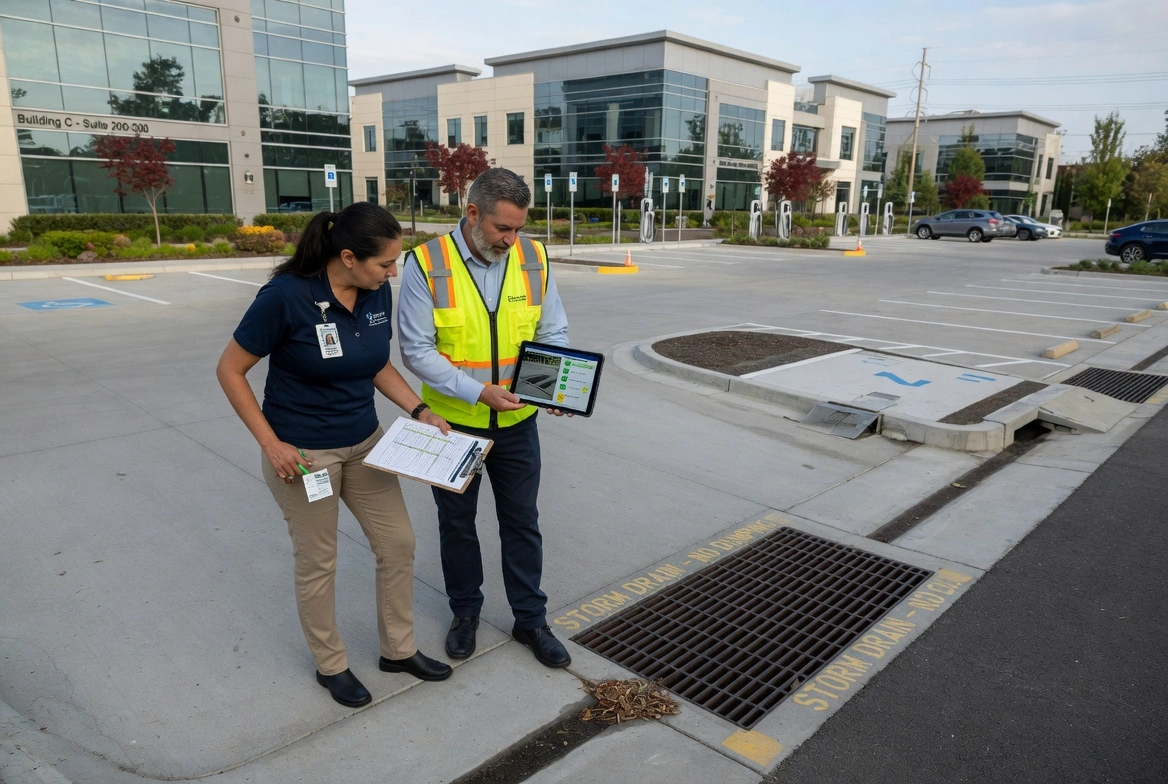
Key Takeaway: NC stormwater compliance for commercial property owners requires meeting National Pollutant Discharge Elimination System (NPDES) permits administered by the NC Department of Environmental Quality (NC DEQ), with violations carrying fines of $2,500–$25,000 per day. Compliance means maintaining Best Management Practices (BMPs), including regular parking lot sweeping, storm drain cleaning, and detention pond maintenance, all backed by documented inspection records. Carolina Sweepers handles stormwater maintenance for 1,000+ commercial properties across NC, making compliance straightforward for property managers.
Table of Contents
- What Are North Carolina’s Stormwater Regulations for Commercial Properties?
- What Is a Stormwater Pollution Prevention Plan (SWPPP)?
- What BMPs Must Commercial Properties Maintain in North Carolina?
- What Fines and Penalties Does NC DEQ Impose?
- Stormwater Compliance Checklist for NC Properties
- How Does Parking Lot Sweeping Support Stormwater Compliance?
- Stormwater Requirements by Major NC Metro Area
- Frequently Asked Questions
- How much do stormwater fines cost in North Carolina?
- Owner vs Tenant Responsibility
- How often must detention ponds be inspected?
- Does my parking lot need a stormwater permit?
- What counts as an illicit discharge?
- Can I reduce my stormwater utility fees?
- What happens during a stormwater inspection?
- Do I need a professional for stormwater maintenance?
- Make NC Stormwater Compliance Simple
What Are North Carolina’s Stormwater Regulations for Commercial Properties?
NC stormwater compliance for commercial property starts with understanding the federal Clean Water Act, enforced through NPDES permits administered by NC DEQ. Any commercial property that disturbs one or more acres of land, or is part of a larger common plan of development, must have stormwater controls in place and maintain them for the life of the property.
The NC DEQ Stormwater Program enforces regulations at both the state and local levels. And in many municipalities across the Triangle, Charlotte Metro, Triad, and coastal regions, local ordinances go beyond state minimums, stacking additional requirements on commercial property owners.
Three primary permit types affect commercial properties:
NC Stormwater Permit Types for Commercial Properties
| Permit Type | Who Needs It | Key Requirements | Administered By |
|---|---|---|---|
| NPDES Phase II MS4 | Properties in urbanized areas | BMP maintenance, good housekeeping, pollution prevention | Local municipality |
| NCG01 (Construction) | Active construction sites 1+ acres | Erosion/sediment control, SWPPP, inspections | NC DEQ |
| Individual Stormwater Permit | Large or high-impact developments | Site-specific BMP design, monitoring, annual reports | NC DEQ |
| Post-Construction Permit | All developed commercial properties | Ongoing BMP maintenance, inspections, documentation | Local/NC DEQ |
Most existing commercial properties fall under Post-Construction permits and local MS4 requirements. In practice, that means the original developer installed stormwater controls (detention ponds, bioretention areas, permeable pavement, or underground chambers) and the current property owner is now legally on the hook for maintaining them.
Here’s the thing: failing to maintain these systems isn’t just a fine risk. NC DEQ can require retroactive remediation costing $50,000–$200,000+ if stormwater infrastructure deteriorates to the point of failure.
What Is a Stormwater Pollution Prevention Plan (SWPPP) and Does Your Property Need One?
A Stormwater Pollution Prevention Plan (SWPPP) is a written document identifying potential pollutant sources on your property and describing the practices you use to keep those pollutants out of storm drains and waterways. SWPPPs are formally required for construction sites and industrial facilities under NPDES permits. But many NC municipalities require commercial properties to maintain equivalent pollution prevention documentation, too.
The EPA’s SWPPP guidance outlines the core components:
- Site description: Property layout, drainage patterns, and discharge points
- Potential pollutant sources: Parking lot runoff, dumpster areas, loading docks, vehicle maintenance areas, landscaping chemicals
- BMPs in place: Sweeping schedules, drain maintenance, spill response procedures, erosion controls
- Inspection schedule: Regular inspections with documented findings and corrective actions
- Responsible parties: Names and roles of personnel responsible for stormwater compliance
In Raleigh, Charlotte, Durham, Greensboro, and Wilmington, commercial properties must maintain stormwater documentation and make it available during inspections. Property managers who lack organized records face citations even when their actual stormwater controls are working fine.
Bottom line: even if your property doesn’t technically require a formal SWPPP, maintaining one protects you during inspections and demonstrates the “reasonable care” standard that limits liability.
What BMPs Must Commercial Properties Maintain in North Carolina?
Best Management Practices (BMPs) are the physical structures and operational procedures that control stormwater runoff quality and quantity. NC DEQ requires commercial property owners to maintain all BMPs installed as conditions of their development permits and to document that maintenance.
Structural BMPs (Physical Infrastructure)
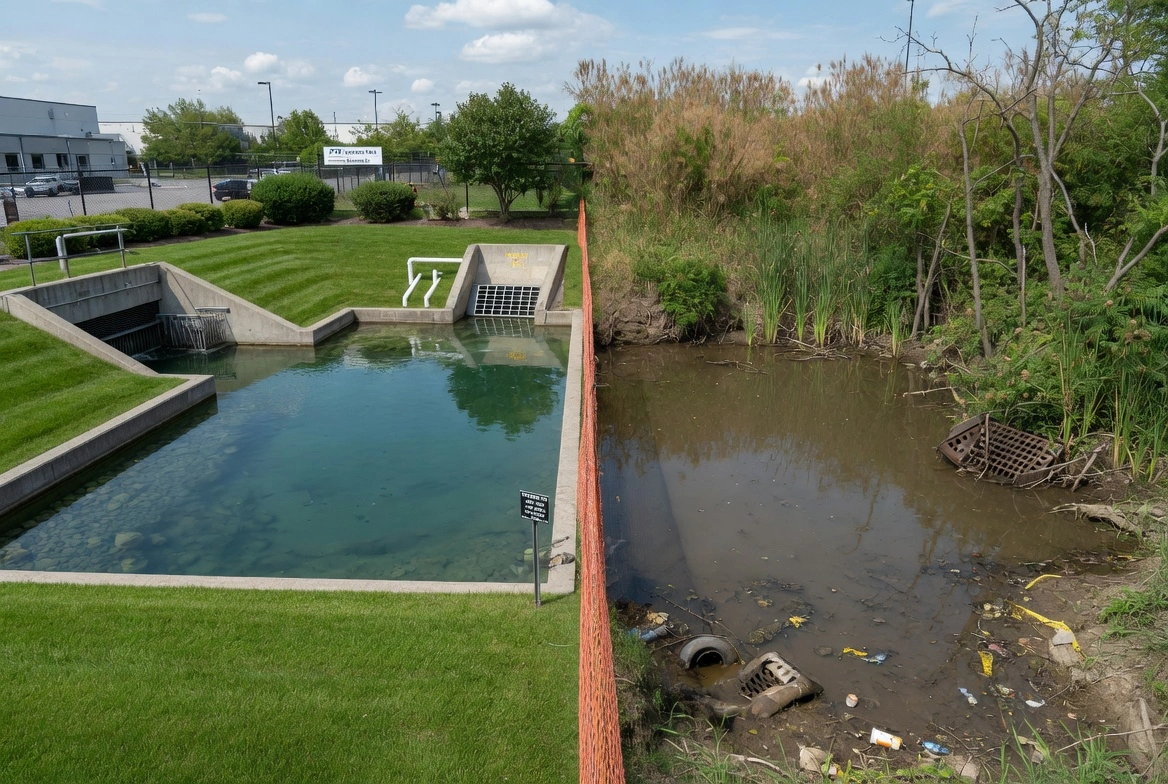
Detention ponds are the most common structural BMP on NC commercial properties. These engineered basins capture stormwater runoff and release it slowly, preventing downstream flooding while allowing sediment to settle. NC DEQ requires annual inspections at minimum, with sediment removed when it reaches 50% of the pond’s design depth.
Skipping detention pond maintenance isn’t an option. A 2024 NC DEQ enforcement report documented 340+ violations related to unmaintained detention facilities statewide, with the highest concentration in Wake, Mecklenburg, and Guilford counties. Fines averaged $5,000–$10,000 per violation.
Bioretention areas (rain gardens) filter stormwater through engineered soil media and native plantings. They need semi-annual inspections, mulch replacement, plant maintenance, and inlet/outlet clearing. Landscaping services familiar with bioretention requirements can fold this into regular grounds care.
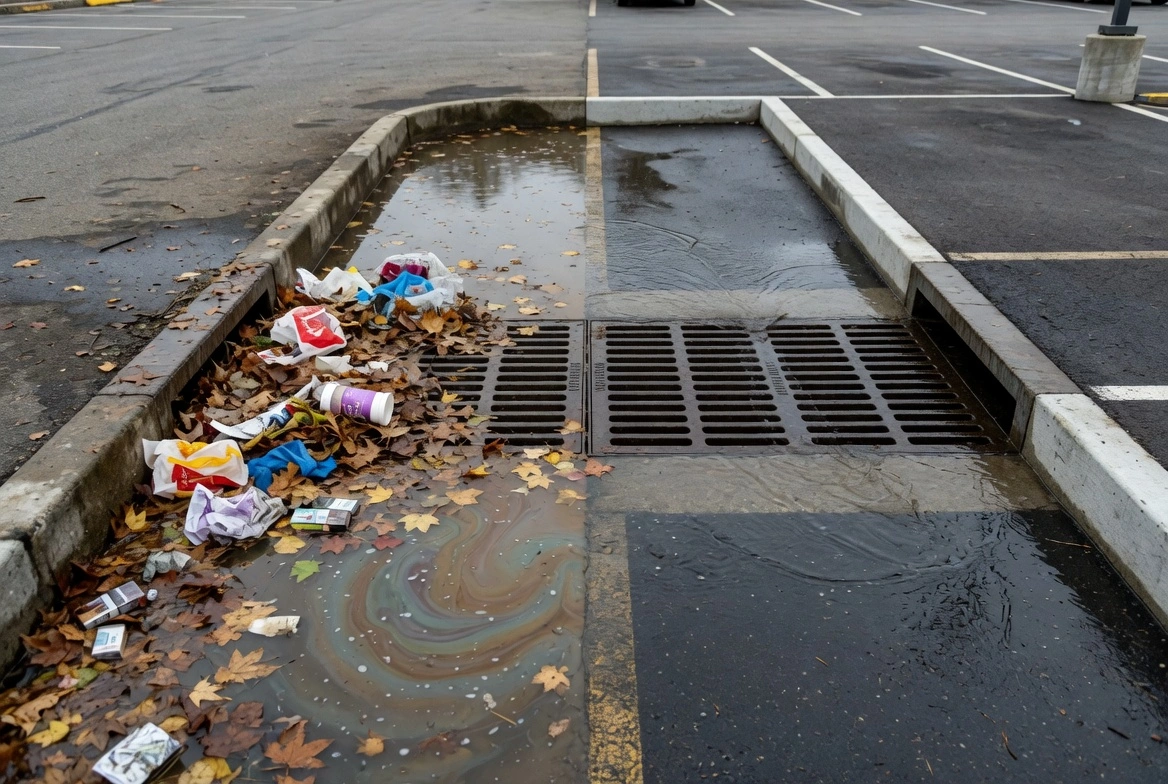
Storm drain inlets and outlets must stay clear of debris, sediment, and vegetation. Blocked inlets cause parking lot flooding. Blocked outlets cause detention pond overflow. Either way, you’re looking at compliance violations and property damage.
Underground stormwater chambers need periodic inspection and sediment removal, typically every 2–3 years depending on how much pollutant load they’re receiving from upstream.
Operational BMPs (Maintenance Practices)
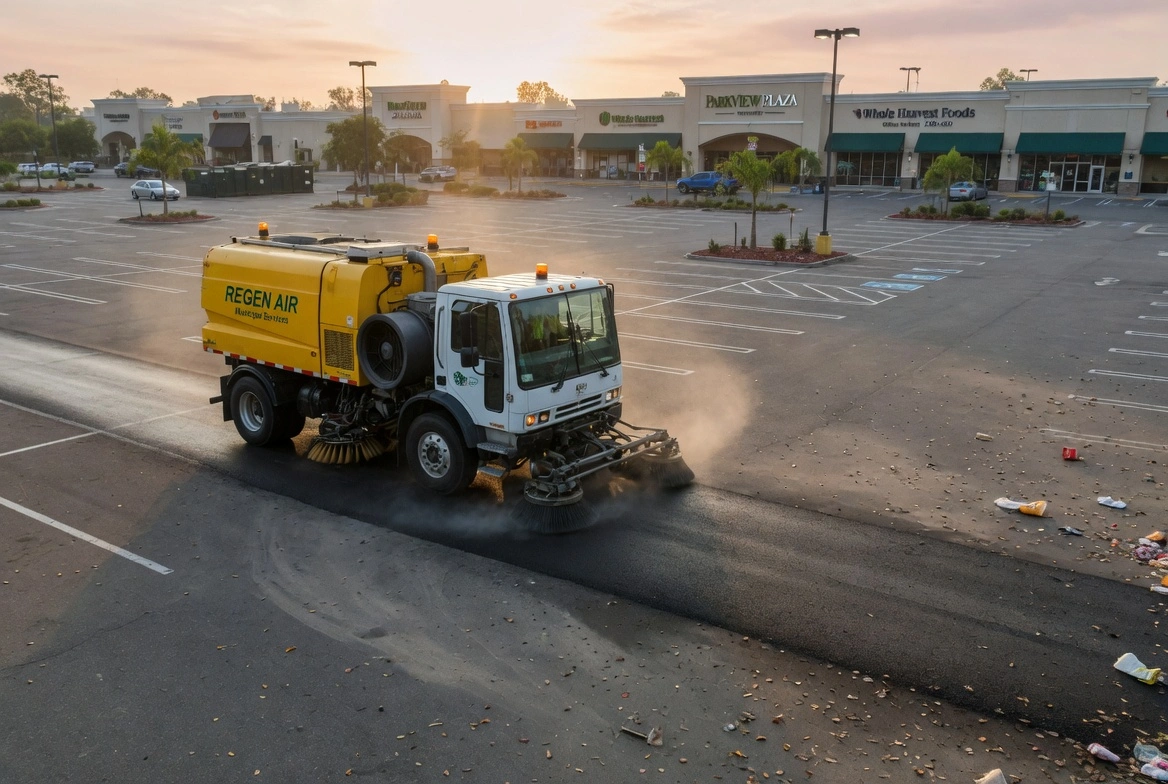
These are the day-to-day practices that keep pollutants out of storm drains:
- Regular parking lot sweeping: The EPA classifies sweeping as a primary BMP for pollutant source control. Weekly parking lot sweeping removes sediment, debris, and contaminants before rain washes them into the drainage system.
- Spill prevention and response: Dumpster areas, loading docks, and vehicle parking areas need containment and cleanup procedures for oil, chemicals, and waste.
- Good housekeeping: Keeping outdoor storage areas clean, managing dumpster lids, preventing material stockpiles near drain inlets.
- Pressure washing with proper containment: Wash water from commercial pressure washing must be captured and disposed of properly, not discharged to storm drains. Professional crews use containment and recovery systems to stay compliant.
What Fines and Penalties Does NC DEQ Impose for Stormwater Violations?
NC DEQ can impose civil penalties of up to $25,000 per day per violation under North Carolina General Statute 143-215.6A. In practice, first-time violations for commercial properties typically land between $2,500 and $10,000. Repeat offenders face the higher end of the range.
Here’s how enforcement usually plays out:
- Inspection: NC DEQ or local stormwater staff inspect the property (often triggered by a complaint or routine audit)
- Notice of Violation (NOV): Written notice identifying specific violations and required corrective actions
- Corrective Action deadline: Typically 30–90 days to fix the problems
- Follow-up inspection: Verification that corrective actions are complete
- Civil penalty: Issued if violations aren’t corrected, or immediately for severe violations
So what gets flagged most often on NC commercial properties?
- Unmaintained detention ponds (sediment buildup, overgrown vegetation, blocked outlets)
- Missing or outdated maintenance records
- Debris and sediment blocking storm drain inlets
- Illicit discharges (wash water, chemicals, or waste entering storm drains)
- Erosion affecting downstream water quality
- Failed or non-functioning BMP infrastructure
Beyond fines, NC DEQ can require property owners to fund remediation projects, install additional stormwater controls, or post environmental compliance bonds. In extreme cases, violations can delay or block property transactions and refinancing.
The Triangle region (Wake, Durham, and Orange counties) and Charlotte Metro (Mecklenburg County) run the most active enforcement programs in the state. If you manage properties in these areas, expect higher inspection frequency and tighter corrective action timelines.
What Does a Stormwater Compliance Checklist Look Like for NC Properties?
A practical compliance checklist covers monthly, quarterly, and annual tasks that keep your property in good standing with documentation ready for inspectors. This one covers the most common BMP types found on NC commercial properties.
Monthly Tasks
- Inspect all storm drain inlets for debris, sediment, and blockages
- Verify parking lot sweeping is occurring on schedule (weekly minimum)
- Check dumpster areas for leaks, overflow, and uncovered containers
- Inspect erosion-prone areas for signs of active erosion
- Walk property perimeter to identify any illicit discharges or dumping
- Document all findings with dates, photos, and corrective actions taken
Quarterly Tasks
- Inspect detention/retention pond embankments, inlet/outlet structures, and vegetation
- Measure sediment depth in detention pond (flag if approaching 50% of design depth)
- Inspect bioretention areas for ponding, clogged media, and plant health
- Clean storm drain grates and remove accumulated sediment
- Pressure wash high-contamination areas (dumpster pads, loading docks) with proper containment
- Review and update SWPPP or pollution prevention documentation
Annual Tasks
- Professional detention pond inspection with written report
- Sediment removal from detention pond if needed (when at 50%+ capacity)
- Underground chamber inspection (camera inspection recommended)
- Full BMP assessment to verify all systems are functioning as designed
- Update site map if property modifications have changed drainage patterns
- Review maintenance contracts to confirm all BMP maintenance is covered
- File any required annual reports with NC DEQ or local stormwater authority
Documentation Requirements
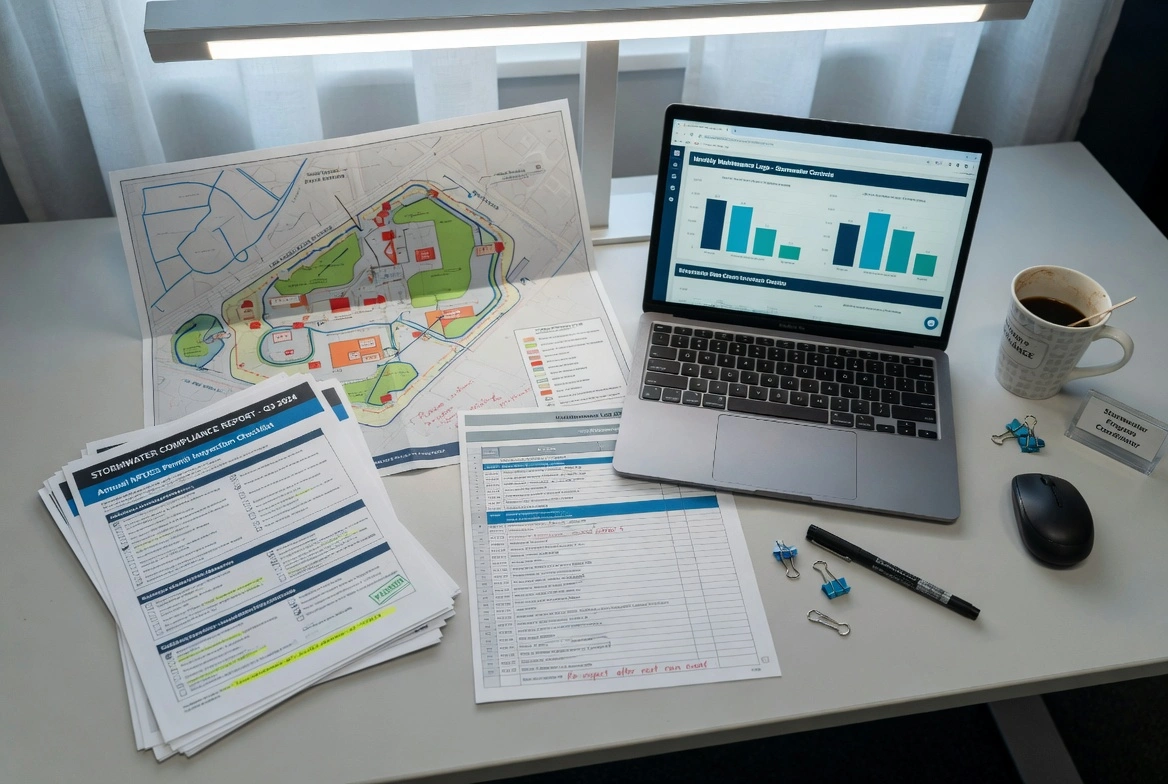
NC DEQ and local stormwater programs require property owners to maintain records for at least three years. Keep organized files including:
- Maintenance logs with dates, work performed, and contractor information
- Inspection reports with photos and findings
- Corrective action records showing when and how problems were resolved
- Contractor certifications and qualifications
- Correspondence with NC DEQ or local stormwater authorities
Carolina Sweepers provides detailed service documentation for every stormwater maintenance visit, including photos, work descriptions, and compliance-ready inspection forms.
How Does Parking Lot Sweeping Contribute to Stormwater Compliance?
Regular parking lot sweeping removes 85–95% of surface pollutants before they reach storm drains. That makes it the single most effective operational BMP for commercial properties. The EPA’s stormwater research consistently identifies street and parking lot sweeping as a “high-efficiency” practice for reducing sediment, heavy metals, and hydrocarbon loads in urban runoff.
How much debris are we talking about? A single unswept commercial parking lot generates 500–1,000 pounds of sediment and debris per acre annually, according to the Water Environment Federation. All of that material flows directly into storm drains during rain events, reducing drainage system capacity and discharging pollutants into local waterways.
Modern regenerative air sweepers, the type Carolina Sweepers uses across our NC service area, capture fine particulates that older mechanical broom sweepers miss. These fine particles carry the highest concentration of heavy metals and hydrocarbons, so advanced sweeping equipment is significantly more effective for compliance.
Frequency matters, too. Properties swept weekly remove substantially more pollutants than those swept monthly or quarterly. NC DEQ inspectors specifically look for evidence of regular sweeping. Visible debris accumulation near drain inlets is one of the quickest triggers for further investigation.
For properties in the Triangle, Charlotte, and coastal NC where enforcement is most active, weekly parking lot sweeping is the baseline that demonstrates you’re meeting your obligations.
What Are the Stormwater Requirements in NC’s Largest Metro Areas?
Each major NC metro area runs its own stormwater program, and requirements often go beyond state minimums. If you manage properties across multiple NC cities, you’ll need to track these local differences.
Raleigh (Wake County)
Raleigh’s stormwater program requires all commercial properties to maintain post-construction BMPs in perpetuity. The city conducts routine inspections and requires annual self-inspection reports for detention ponds and other structural BMPs. Stormwater utility fees are based on impervious surface area, typically $4–$8 per 1,000 sq ft of impervious cover per month.
Charlotte (Mecklenburg County)
Charlotte-Mecklenburg Storm Water Services runs one of the most active stormwater programs in the Southeast. Commercial properties must comply with post-construction ordinances, maintain BMPs per approved designs, and respond to inspection findings within 30 days. Mecklenburg County has a dedicated enforcement team that actively inspects commercial properties, so this isn’t a “wait and see” jurisdiction. For a deeper dive on Charlotte-specific BMP rules, see our Charlotte stormwater BMP compliance guide.
Greensboro / Winston-Salem (Triad)
The Triad region operates under the Piedmont Triad Regional Council’s MS4 permit. Guilford and Forsyth counties require commercial properties to maintain stormwater documentation and respond to inspections. Enforcement has ramped up since 2023 as the region’s urbanization accelerates.
Wilmington (Coastal)
Coastal properties face additional requirements under NC’s Coastal Stormwater Rules, which impose stricter impervious surface limits and require enhanced stormwater treatment. Properties within 575 feet of shellfishing waters or Outstanding Resource Waters have the most restrictive requirements in the state.
Property managers overseeing NC portfolios can simplify all of this by working with a single maintenance provider that knows each jurisdiction’s rules. Carolina Sweepers serves all major NC metro areas and tailors stormwater maintenance programs to local compliance standards.
Frequently Asked Questions
How much do stormwater fines cost in North Carolina?
NC DEQ can impose civil penalties up to $25,000 per day per violation under state statute. First-time commercial property violations typically result in fines of $2,500–$10,000. Repeat violations, severe contamination, or failure to correct cited problems within deadlines push penalties toward the maximum. Remediation costs can add $50,000–$200,000 beyond fines.
Who is responsible for stormwater compliance — the property owner or tenant?
The property owner bears primary legal responsibility in North Carolina, regardless of lease arrangements. Property managers can include stormwater maintenance obligations in lease agreements and recover costs through common area maintenance (CAM) charges. But the owner remains liable to NC DEQ even if a tenant causes the violation.
How often must detention ponds be inspected in NC?
NC DEQ requires annual inspections at minimum by someone qualified to assess their function. Many local jurisdictions require semi-annual inspections. Sediment must be removed when accumulation reaches 50% of the pond’s design storage volume. Professional inspection reports should be kept for at least three years.
Does my parking lot need a stormwater permit?
Most existing commercial parking lots operate under post-construction stormwater permits issued during original development. You likely don’t need a new permit unless you’re expanding impervious surface area or modifying drainage patterns. That said, you are required to maintain any BMPs installed as conditions of the existing permit. Contact your local stormwater authority to confirm your permit status.
What counts as an illicit discharge in North Carolina?
Any non-stormwater discharge to a storm drain system is potentially illicit under NC regulations. Common examples: wash water from pressure washing (without containment), vehicle fluids, paint waste, dumpster leachate, pool or spa discharge, and landscape irrigation runoff containing fertilizers or pesticides. Sanitary sewer overflows that reach storm drains also qualify.
Can I reduce my stormwater utility fees?
Many NC municipalities offer stormwater fee credits for properties that go beyond minimum BMP requirements. Raleigh, Charlotte, and Durham all have credit programs. Credits typically range from 10–40% of the stormwater fee and require documented BMP maintenance. Regular sweeping, rain gardens, and permeable pavement installations commonly qualify.
What happens during a stormwater inspection?
Inspectors walk the property examining storm drain inlets, detention ponds, bioretention areas, dumpster enclosures, loading docks, and parking surfaces. They’re looking for debris near drains, sediment accumulation, erosion, illicit discharges, and evidence of BMP maintenance. They’ll request maintenance records and inspection logs. Expect 30–60 minutes for a standard commercial property.
Do I need a professional for stormwater maintenance?
You can handle some tasks yourself, but NC DEQ and most local programs expect professional-grade BMP maintenance for detention ponds, underground chambers, and specialized systems. Professional providers also supply the documentation format inspectors expect. Carolina Sweepers’ stormwater maintenance program covers all required services with compliance-ready documentation.
Make NC Stormwater Compliance Simple
NC stormwater compliance for commercial property doesn’t need to be complicated. The regulations are clear: maintain your BMPs, keep your property clean, document your work, and respond promptly when issues come up. Most commercial property managers run into trouble not because the requirements are unreasonable, but because maintenance falls through the cracks when you’re juggling multiple vendors and responsibilities.
Carolina Sweepers has maintained stormwater systems on 1,000+ commercial properties across North Carolina for over 26 years. We know the specific requirements in Raleigh, Charlotte, Greensboro, Wilmington, and every market in between, because we maintain properties and work with inspectors in all of them.
Our stormwater maintenance services cover detention pond cleaning, storm drain maintenance, parking lot sweeping, erosion control, and full documentation, all under one contract with one point of contact. You get compliance without the coordination headache.
Ready to simplify your stormwater compliance? Contact Carolina Sweepers for a free property assessment. We’ll review your BMP inventory, evaluate your current compliance status, and build a maintenance program that keeps NC DEQ satisfied so you can focus on managing your property.
No Comments yet!